Uses of an ISO 22301 Checklist
ISO 22301 details the requirements for implementing, creating, and maintaining a business continuity plan (BCP) and a business continuity management system (BCMS). The standard gives organizations a structured framework for preparing for, responding to, and recovering from disruptions.
Some key areas an ISO 22301 checklist helps organizations address include:
Understanding organizational needs: Identifying the internal and external factors that affect business continuity planning
Establishing continuity plans: Documenting the procedures and responses needed to keep operations running during a disruption
Maintaining operational processes: Defining the organizational capabilities required for different disruption scenarios
Driving continuous improvements: Using qualitative and quantitative data to improve business processes over time
With this, organizations can reduce financial losses during unexpected events, build a competitive advantage, and protect both their people and their environment. It also creates consistency, making it easier to align ISO 22301 with other standards such as ISO 9001, ISO 14001, and ISO/IEC 27001.
What are the Elements of an ISO 22301 Checklist?
An ISO 22301 checklist can be used by anyone in an organization. It can be accomplished by business owners from a top-down level in order to implement changes company-wide. It can also be used by managers in the mid or lower levels to create new policies.
A typical ISO 22301 checklist should include the following sections:
Context of the organization: For understanding the organization, its context, its interested parties, its BCMS, and its legal and regulatory requirements
Leadership: For analyzing the current leadership policies and practices in place as a whole and in connection to business continuity plans
Planning: For determining risks to prepare for and the plans to address them
Support: For the communication tactics to utilize in different situations, documentation processes to implement, and the level of competencies required for different staff
Operation: For conducting risk assessments, creating business continuity operational plans to follow, and the order in which to do so
Performance evaluation: For conducting an analysis of the business continuity plans, the BCMS, and other internal auditing tasks
Improvement: For identifying points for improvement
How to Use an ISO 22301 Checklist
An ISO 22301 checklist is most effective when treated as a living tool — not a one-time exercise. Whether you're preparing for your first certification audit or maintaining an existing BCMS, following a structured approach ensures nothing falls through the cracks. Here's how to get the most out of it:
1. Define the scope of your BCMS first. Clarify which business units, sites, and processes are covered and which aren't before working through any checklist item.
2. Conduct a risk assessment and Business Impact Analysis (BIA). Use the checklist to guide your risk assessment and business impact analysis, identifying your biggest threats and most critical functions.
3. Assign ownership to each checklist section. Give each section a named owner and avoid making it a group responsibility to ensure clear accountability and easier audit tracking.
4. Use it as an audit preparation tool. Work through each clause, document findings, and flag gaps before an external auditor does. BSI Group recommends this as a maturity self-assessment.
5. Apply the PDCA cycle to keep improving. Use the Plan-Do-Check-Act (PDCA) cycle to regularly review outcomes, run drills, and update plans as your organization changes.
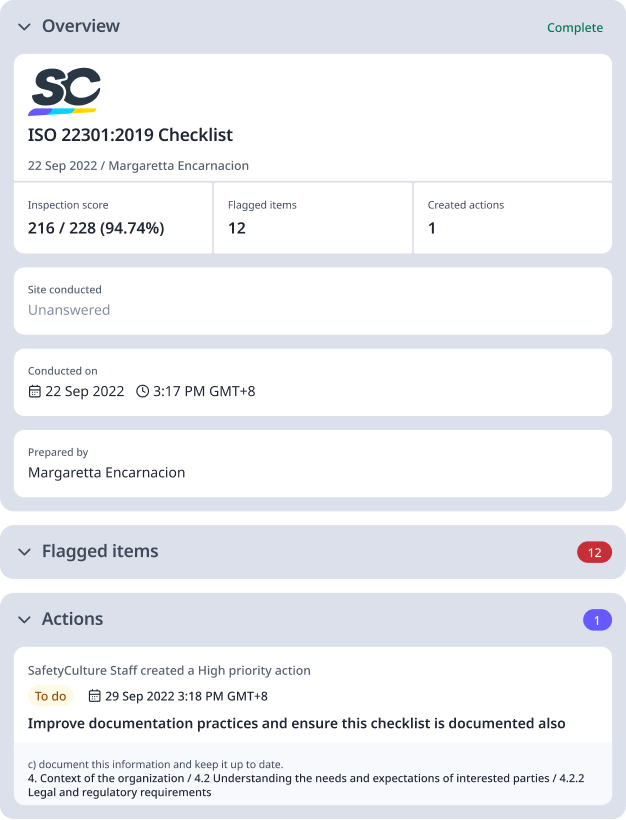
Sample ISO 22301 Checklist PDF Report
Below is an example of how an ISO 22301 checklist looks when completed:
Preview the ISO 22301 Checklist PDF Report