
Best Practices
Why some businesses survive crises and others don't
Share article
A Governance, Risk, Compliance (GRC) framework only works when the three pillars work together as one connected system.
Most businesses don't silo governance, risks, and compliance on purpose, but the separation alone is enough to let risks go undetected.
Most crises start as risks, and most are preventable with the right GRC systems in place.
Back in 2016, a major US bank made headlines when employees were caught opening millions of fake bank and credit card accounts, all while customers had no clue.
The fallout was massive.
$185M in regulatory fines. A $3B settlement. A CEO resignation. A brand that took years to recover.
Three things failed:
First, it was compliance. There was no system flagging or catching the fraudulent account openings as they happened.
Then, risk management wasn’t there either. Their sales targets were just too unrealistic that it was obvious some employees would cut corners.
And when the story broke, crisis management was too slow and defensive. They blamed employees instead of owning up to the systemic failure. In the end, that made everything worse.
This is what happens when a Governance, Risk, and Compliance (GRC) framework isn't in place, and compliance, risk, and crisis management are all working separately, instead of together.
Having a GRC framework is the big answer to how organizations can manage governance, risk, and compliance all together. It gives businesses a structured way to stay on top of risks before they turn into something bigger.
Take a data breach for example. First, the compliance team flags a gap in data protection obligations. Then, the risk team does a risk assessment on the potential impact of the breach. After, the governing heads set the rules ahead of time so when a breach happens, everyone already knows who responds, who decides, and how it gets resolved.
But when these functions operate in silos, the gaps never get flagged. The risks never get addressed. And by the time someone acts, the risks have already evolved into a crisis.
A GRC framework couldn't be complete without these three core components. Each one plays a different but necessary role when it comes to running a business.
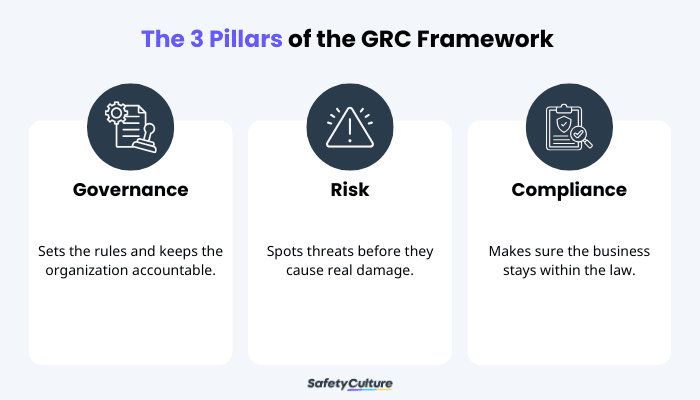
The 3 Pillars of the GRC Framework
Here are the three:
Compliance: This keeps the business legally covered by making sure it meets every regulation and company policies that apply to it. It covers everything from data privacy laws to industry-specific regulations that the business is legally required to follow.
Risk management: This involves spotting financial, operational, or reputational threats before they cause damage. Without it, risks can quietly escalate into full-blown crises. The difference is simple: a risk is something you can still act on, a crisis is something you're already dealing with.
Governance: This is where the rules on who leads, how things get done, and what keeps the organization on track are set. It's basically the backbone of how a business runs, from company policies to who's responsible for what. Without it, nobody knows who's responsible when things go wrong.
When isolated from one another, these three components just won’t work. Compliance needs risk management to know what to prioritize. Risk management needs governance to know who acts on what. And effective governance needs compliance to make sure the rules are actually being followed. But once all three work together in a GRC framework, the business stops reacting and starts staying ahead.
Your business will be open to all kinds of risks if compliance and risk management aren't on top of things. These could be human risks, financial risks, or operational risks that could all start to become crises if not dealt with properly.
Here are some of the most common types of compliance risk for businesses:
Conflicts of interest: When personal or financial interests of employees or leadership get in the way of work.
Market fluctuations: When unexpected economic shifts make it harder for a business to stay compliant.
Conduct issues: When employees or leadership behave in ways that break internal rules or legal standards.
Corrupt practices: When unethical practices like bribery or fraud break the law.
Privacy breaches: When personal or sensitive data is exposed or mishandled in ways that break data protection laws.
Without governance, risk management, and compliance working together in clearly defined GRC frameworks, these risks don't stay small. They build on each other, and quietly take down businesses that thought they had it covered.
Simplify risk management and compliance with our centralized platform, designed to integrate and automate processes for optimal governance.
Some businesses never questioned it. Each function got its own tools, job titles, and certifications, built independently and reported separately. Over time that just became the norm, and nobody pushed back.
Leadership also found it easier to manage their GRC frameworks in parts. Each function gets a point person, each lead owns their KPIs, and as long as there's a touchpoint between them, things seem fine.
The problem is that "seems fine" isn't the same as integrated, as risks can still slip through the cracks.
The fix is straightforward: introduce a unified GRC framework from the start. But if the silos are already baked in, you could always start small. Build the connective tissue first: shared data, shared accountability, a clear process for escalating issues.
You don't have to restructure the whole org chart. You just need the three functions talking to each other. And with digital GRC platforms now able to pull compliance monitoring, risk assessments, incident reporting, and governance reporting into one place, there's really no excuse not to.
When compliance, risk, and crisis management work together under one GRC framework, the whole organization feels it. Here's what that looks like in practice:
Surprise risks become less common: Shifts teams from reactive to proactive, catching risks earlier before they have a chance to turn into a full-blown crisis.
Regulatory penalties get avoided: Gives teams full visibility across compliance obligations so issues get fixed before they become violations.
Crisis response gets faster and more coordinated: Eliminates the scramble of figuring out who owns what when something goes wrong.
Stakeholder trust gets stronger: Signals to regulators, investors, and customers that the organization is well-run and accountable.
We needed a tool that would standardize the approach to conducting inspections, afford control over master templates, could set audit schedules and issue reminders, and provide a real-time view of compliance data aggregated at a whole of company level.
One great example of a unified GRC framework in practice is that of Aveo Group’s, one of Australia's largest aged care operators. Regularly, they’re managing over 90 retirement communities and 12,000 residents. At that scale, compliance and risk are very real. Digital operations improvement platforms like SafetyCulture were able to help them replace paper-based audits with real-time monitoring across the entire network. So when COVID-19 hit, they were prepared and ready to act swiftly.
Important notice
The information contained in this article is general in nature and you should consider whether the information is appropriate to your specific needs. Legal and other matters referred to in this article are based on our interpretation of laws existing at the time and should not be relied on in place of professional advice. We are not responsible for the content of any site owned by a third party that may be linked to this article. SafetyCulture disclaims all liability (except for any liability which by law cannot be excluded) for any error, inaccuracy, or omission from the information contained in this article, any site linked to this article, and any loss or damage suffered by any person directly or indirectly through relying on this information.


