Best Practices
From burnout to bottom line: why psychosocial risk belongs in your risk register
Share article
Psychosocial risk is a fundamental business hazard rooted in organizational structures rather than individual employee weaknesses.
Chronic burnout and widespread disengagement result from broken systems and cost global organizations billions in lost productivity.
Operational metrics like rising error rates, high turnover, and frequent incidents serve as early warning signs of underlying systemic risks.
In the US alone, stress costs employees more than $300 billion in absenteeism, reduced productivity, accidents, and insurance costs. For the rest of the world, depression and anxiety erase an estimated $1 trillion in economic output annually.
And yet, when most leadership review their risk registers, psychosocial risk is nowhere to be found.
That's not a knowledge gap. It's a blind spot with a price tag.
Psychosocial risk is more than just what people feel. It’s the backbone of your team’s performance. Treating it as a mere wellbeing issue misses the point entirely.
This is a business risk. It’s about time it’s managed like one.
Most people only have a rough idea of what workplace stress looks like. But psychological risk is something more specific and structural.
According to the International Labour Organization (ILO), psychological risks are defined as arising from the design, organization, and management of work that can result in psychological, social, or physical harm to workers.
It’s chronic, systemic, and caused by the conditions of work, not just the volume of it.
Some of the everyday examples at work include:
Work overload: heavy workloads, poor staffing, lack of control, and unclear roles.
Shiftwork and long hours: linked to stress, fatigue, and serious health conditions.
Fatigue: impairs thinking, mood, and decision-making, raising the likelihood of errors and injuries.
Workplace violence: physical, verbal, or threatening behavior from clients or coworkers.
Incivility: rude behavior that, if ignored, can escalate to bullying or violence.
Bullying: repeated harmful acts meant to humiliate or degrade.
The problem with these risks is that it’s easy to blame individual fragility, or the inability of an employee to withstand pressure at work. But that’s not really the case.
These are system failures.
Which is exactly why it goes unaddressed. When an employee burns out, it's easier to blame their circumstances than to examine the conditions that put them there.
Simplify risk management and compliance with our centralized platform, designed to integrate and automate processes for optimal governance.
The numbers are staggering, and might even surprise you. Let’s break down the ways psychosocial risks quietly erode your dollars:
Disengagement costs the global economy an estimated $8.9 trillion annually in lost productivity. Relatedly, disengaged employees cost their organisations roughly 18% of their annual salary in lost output.
Poor psychosocial conditions like job strain, overload and cultures of silence directly affect physical safety. Occupational stressors contribute to 37% of accidents and injuries in industrial settings.
Following that, workers who feel discouraged from speaking up are 2.4 times more likely to have experienced a work injury. Stress impairs concentration, decision-making and hazard recognition, all of which can lead to accidents in the workplace.
A stressed workplace often can't operate as smoothly, and it shows. Overload drives higher errors, and disengaged employees do the minimum. Teams under sustained pressure cut corners not out of carelessness, but because the system gives them no viable alternative.
The thing about psychosocial risks is that they don’t announce themselves. They build quietly, and linger until they show up in your turnover rate, or in incident data. The signs are easy to spot once you know where and what to look out for. Some examples can be:
Workload and work design: Frequent overtime has become the norm and not the exception, breaks are routinely skipped or cut short, chronic understaffing has become a regular issue, or teams are in constant "firefighting" mode.
Culture and behaviour: The "that's just how it is here" mindset is the response to concerns about pressure or stress.
Data and performance signals: Rising error rates, near-misses, or quality escapes not explained by process changes, declining engagement scores or falling participation in feedback mechanisms.
The reason psychosocial risk gets ignored isn't that leaders don't care about their people. It's that there's no clear process for managing something that feels intangible.
Here’s a cheat sheet to start with:
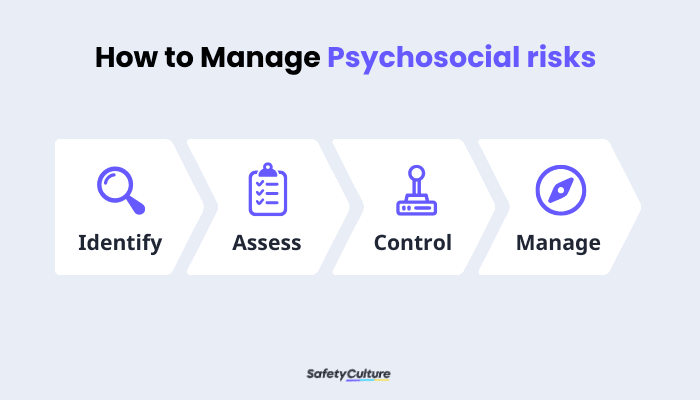
Identify → Assess → Control → Monitor
Identify: Surface the hazards. Use surveys, structured conversations, incident data, and observation to understand where the systemic pressure points are.
Assess: Evaluate severity and likelihood. Determine which hazards are most prevalent and which groups or roles are most exposed, and prioritize by impact, not by visibility.
Control: Implement proportionate controls. Not wellbeing programs as a substitute for structural change, but genuine redesign of the conditions creating the risk.
Monitor: Track effectiveness. This isn't a one-and-done exercise, it's an ongoing cycle, the same as any physical safety process.
The distinction is important: this is about the system, not the individual.
The main challenge with addressing psychosocial risks is visibility.
Physical risks can be observed, psychosocial ones can't. But digital tools can help close that gap by helping with the following:
Making risks and workloads visible: Real-time capture of psychosocial risk signals through inspections, observations, and structured check-ins gives leaders an honest, current picture of conditions on the ground.
Turning insight into action: When you identify risk without acting on it, you erode trust faster than not asking at all, so use workflow tools that let leaders assign corrective actions, track progress, and close the loop, so reporting actually leads somewhere, and people see that their input matters
Building manager capability: Supporting people with training and communication with training tools improve capability building, helping managers identify the signs, have the conversations, and respond appropriately when issues surface.
Visible or not, psychosocial risks already exist in your business. It’s in the crevices of your absent data, your incident records, your quality escapes, your turnover figures.
The question you should be asking isn't whether it's a risk—it's whether you're managing it or absorbing it.
Most organisations absorb it in sick days, in quiet quitting, in the employee who just stops raising issues.
That's not resilience. That's a system running on borrowed time.
The good news? You don't need to overhaul everything overnight. Start with accountability.
Acknowledge that psychosocial risk is in your risk register. Start there. That’s where it belongs.
Important notice
The information contained in this article is general in nature and you should consider whether the information is appropriate to your specific needs. Legal and other matters referred to in this article are based on our interpretation of laws existing at the time and should not be relied on in place of professional advice. We are not responsible for the content of any site owned by a third party that may be linked to this article. SafetyCulture disclaims all liability (except for any liability which by law cannot be excluded) for any error, inaccuracy, or omission from the information contained in this article, any site linked to this article, and any loss or damage suffered by any person directly or indirectly through relying on this information.