
Best Practices
Heat doesn't kill workers. Unpreparedness does.
Share article
Summers are getting hotter in the US, and 2026 is on track to be one of the warmest years on record.
Despite not having a federal heat standard in the US yet, employers still need to act on recognized hazards as inspectors can still show up unannounced.
When heat stroke hits, call 911 first and cool the worker down second.
At the 2022 World Cup in Qatar, fans were treated to some of the best football games in years.
The atmosphere was just electric. Packed stands, chants, and cooler temperatures than anyone expected.
But behind the spectacle was a far darker story: The workers who built those stadiums, many of them migrants laboring in extreme heat, were dying. Qatar’s Secretary General said on live television that between 400 and 500 workers died building the stadiums in temperatures reaching 122°F (50°C).
That's what happens when nobody in management is accountable for heat safety. No monitoring, no protocols, no oversight.
Heat is the leading weather-related killer in the US, beating hurricanes and floods. And with no real federal heat standard in place, protecting workers from it falls on managers.
June and July are consistently the hottest months in the US, and summers are just about to get hotter. The National Oceanic and Atmospheric Administration (NOAA) confirmed that 2025 was the fourth-warmest year on record in the US. And 2026 looks to set new records with a Super El Niño possibly coming, which could just be the hottest ever.
In the workplace, the problem gets even bigger. High temperatures contributed to 28,000 workplace injuries in the US in 2023, and when employers don't act, it all eventually adds up. A 2022 Public Citizen report put the total cost to the US economy at nearly $100 billion a year.
The industries hit hardest are construction, transportation and logistics, warehousing, agriculture, and manufacturing. Indoor workers also aren't off the hook; bakeries, commercial kitchens, and foundries can reach dangerous heat levels regardless of what's happening outside.
Just because a federal heat standard doesn't exist yet doesn't mean there are no guardrails. Occupational Safety and Health Administration (OSHA) has been working on a federal heat rule since 2021 and held public hearings on it as recently as last year. In the meantime, its Heat National Emphasis Program (NEP), the policy that lets inspectors show up unannounced at high-risk worksites, was just renewed to last until 2031.
A lot of the heavy lifting is done by OSHA’s General Duty Clause (Section 5(a)(1)), which requires employers to protect workers from recognized heat-related hazards. So if heat is a problem, managers have a legal obligation to act, with or without a specific rule spelling out how.
The National Weather Service breaks heat risk into four tiers, giving managers a simple guide on when hot is “too hot”:
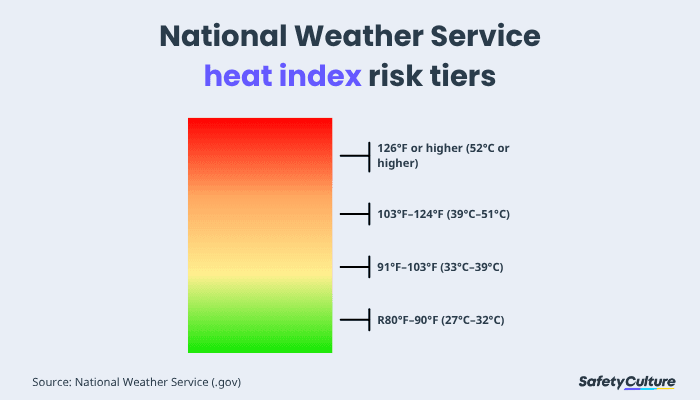
National Weather Service heat index risk tiers
80°F–90°F Heat Index (HI) (27°C–32°C)
91°F–103°F Heat Index (HI) (33°C–39°C)
103°F–124°F Heat Index (HI) (39°C–51°C)
126°F or higher Heat Index (HI) (52°C or higher)
Now, the spotlight is on the managers to take action because they sit between policy and the people doing the work. They're close enough to see the signs, and senior enough to do something about it.
Here are some ways managers can help prevent heat illness at work:
Acclimatization is what happens when you slowly but gradually expose someone to the heat so their body can better adapt. A 7 to 14 day acclimatization process is recommended by both the Centers for Disease Control and Prevention (CDC) and OSHA with no more than 20% heat exposure on the first day. New workers or those returning from extended leaves are also expected to go through acclimatization.
Water, rest, and shade are non-negotiables in the workplace, especially in industries like construction. This means ensuring at least one quart of water per hour, roughly two standard water bottles. Rest breaks should be scheduled and take place in shaded areas, not left up to workers to ask for when they feel sick. Managers should also be watching for early signs, not just waiting for someone to speak up.
Before even doing anything under the sun or near heat-emitting machines, managers should always check the heat index of their workplace. This value accounts for both temperature and humidity, and gives a more accurate picture of actual risk. Take note that direct sun exposure can add up to 15°F (8.3°C) to the apparent temperature, as well as heat from equipment and surfaces.
Managers are responsible for making sure the whole team knows what to do when a colleague shows signs of heat illness. The symptom progression goes from heavy sweating and cramps, to dizziness and nausea, then stopping sweating and becoming confused. That last stage is heat stroke and needs a 911 call immediately. Documenting that this training happened is also part of a solid heat illness prevention plan.
Cultivate a safe working environment and streamline compliance with our EHS solutions.
The most common failure point in heat safety isn't that managers don't care. It's that the warning signs are invisible until it's too late.
With real-time technology, managers can see problems before they become emergencies. Digital tools can run pre-shift heat hazard assessments that capture on-site conditions like temperature, humidity, sun exposure, and workload level, creating an auditable record for every shift. This also makes unannounced OSHA inspections go a lot smoother.
Digital pre-shift checks: A digital heat safety checklist completed before each shift makes it easier to track your colleagues. Managers can log real-time conditions, acclimatization windows, and corrective actions before anyone gets hurt.
Digital training courses: Online heat safety training gives managers a way to onboard workers on heat illness prevention before they even start the day. It also ensures the whole team knows exactly what to do when an emergency hits.
Wearable monitoring devices: Smart Personal Protective Equipment (PPE) like connected helmets and wristbands can monitor workers' body temperature and heart rate in real time. When vitals reach dangerous levels, managers will get alerted.
Environmental sensors: Internet of Things (IoT) sensors placed around a worksite continuously track temperature, humidity, and radiant heat conditions. When readings cross a threshold, managers will get alerted.
Near-miss reporting: Digital tools that make it easy for workers to log near-misses like a sudden dizzy spell or a worker who just had to sit down, so managers can act on without wasting precious time.
Important notice
The information contained in this article is general in nature and you should consider whether the information is appropriate to your specific needs. Legal and other matters referred to in this article are based on our interpretation of laws existing at the time and should not be relied on in place of professional advice. We are not responsible for the content of any site owned by a third party that may be linked to this article. SafetyCulture disclaims all liability (except for any liability which by law cannot be excluded) for any error, inaccuracy, or omission from the information contained in this article, any site linked to this article, and any loss or damage suffered by any person directly or indirectly through relying on this information.


