Machine Risk Assessment for Industrial Safety
Learn about the process of machine risk assessment, from hazard identification to implementing safety measures, to protect workers and improve operational safety.

Learn about the process of machine risk assessment, from hazard identification to implementing safety measures, to protect workers and improve operational safety.
Published 27 Apr 2026
Article by
6 min read
Machinery risk assessment is a structured safety evaluation used to identify, analyze, and mitigate industrial machinery hazards throughout its lifecycle. Guided by safety standards such as ISO 12100, the process evaluates equipment-related risks to implement appropriate controls, ensuring worker safety, system integrity, and regulatory compliance.
While risk assessment covers a broad spectrum of hazards, machinery remains a primary focus due to its significant injury potential. In fact, heavy equipment accounts for a huge chunk of industry fatalities, which proves that this is a crucial need. Here are some reasons on the importance of machine risk assessment:
Prevents severe injuries and fatalities: Machinery accidents involve point-of-operation hazards and moving parts. Recognizing these through routine checks can minimize serious injuries and prevent fatalities.
Reduces amputations and severe mechanical injuries: 30% of machinery-related injuries involve amputations or deep lacerations, making proactive hazard evaluation critical.
Identifies unsafe equipment conditions: Inspections can reveal how many facilities have unguarded machinery. Pre-work inspections detect missing guards, faulty controls, and unsafe configurations to ensure safety conditions are met.
Improves operational reliability: Risk assessments pinpoint mechanical risks to ensure equipment operates within safe parameters, protecting both workers and production continuity.
Minimizes financial and productivity losses: Incidents drain resources through medical claims, legal compensation, and operational downtime. A proactive review mitigates these financial risks and protects worker well-being throughout their tasks, allowing them to work with confidence.
Global regulatory bodies enforce zero-tolerance safety mandates to prevent industrial fatalities. Because the stakes involve human life, non-compliance is met with severe penalties. Here are some standards to take note of:
ISO 12100 is considered to be the global standard for conducting machine-related risk assessments.
ISO 13849-1 focuses on industrial safety equipment and control systems, ensuring risks are within acceptable levels.
IEC 62061 quantifies the reliability of safety functions so engineers can design controls that meet acceptable thresholds.
OSHA Machinery Safety Requirements requires hazard identification, machine guarding, LOTO procedures, and other worker protection measures within US operations.
Work Health and Safety Regulations in Australia requires employers to conduct risk assessment and implement engineering controls.
The Machinery Directive of the EU requires equipment manufacturers to conduct risk assessments, prepare technical files, and demonstrate compliance to obtain the CE marking.
From the moment a machine is ready for transport to its initial power-on, equipment introduces hazards that are often overlooked. It’s important to be aware of common machine hazards and create strategies that effectively mitigate the inherent risks associated with industrial machinery. Get to know some workplace hazards throughout the machine’s lifecycle:
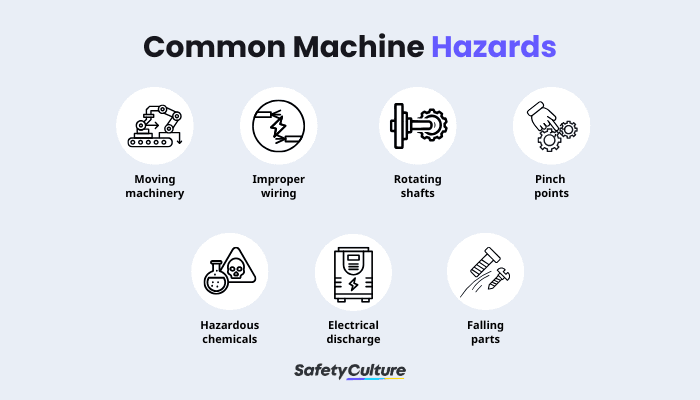
Transport: Crush injuries and struck-by incidents can happen while loading, unloading, and moving machinery. Equipment and machinery can also become unstable, shift, and fall during transport.
Installation: Incomplete assembly, misalignment, or improper wiring can create hazards. Electrical shocks, pinch points, or structural failures can happen, leading to serious injuries.
Operation: Moving parts, rotating shafts, and high temperatures can cause entanglement, cutting injuries, and burns. These typically happen when safeguards or emergency stops systems are absent or are malfunctioning.
Setup: Workers sometimes need to adjust components near moving parts. Pinch points, unexpected startup, and tool contact with sharp components can happen, which cause injuries.
Cleaning: Incomplete power-down procedures expose cleaners to life-threatening risks from rotating machinery, hazardous chemicals, and sharp-edge contact.
Maintenance: Without strict lockout-tagout (LOTO) controls, internal maintenance and disassembly pose life-threatening risks from residual energy, electrical discharge, and unexpected mechanical movement.
Decommissioning: Dismantling heavy components once machines are retired can lead to falling parts, sharp edges, and hazardous material exposure. Improper handling during disposal can also create safety risks (e.g., chemical, electrical).
A machine safety risk assessment works best when performed using a structured framework. This step-by-step process serves as the foundation for selecting and deploying the most effective risk mitigation strategies.
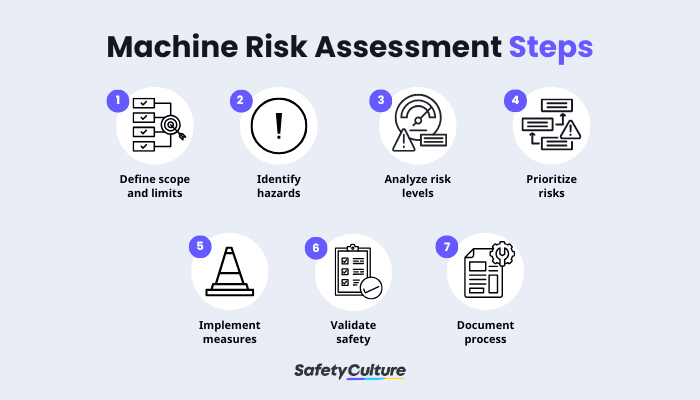
Establish the machine's intended use, operating modes, and environmental constraints from startup to decommissioning. This first step is critical, as hazards typically emerge during unusual operating or environmental conditions, which can be easily overlooked.
Examine all possible sources of hazards, from machine components to human interactions during specific tasks. Using digital hazard checklists can help when the following inspections or reviews are being conducted:
Workplace inspections and machine walkthroughs
Reviewing design drawings and manuals
Observing operator tasks and workflows
Reviewing incident or near-miss reports
Consulting operators and maintenance staff
Next, estimate risk by quantifying the potential severity of injury and the probability of occurrence. This evaluation determines whether current safety measures are sufficient or there’s a need to implement more robust controls.
To accurately measure risk, companies must utilize internationally recognized reliability metrics, especially those aligned with ISO 12100 and EU Machinery Directive. Here are some global benchmarks:
Metric | Parameter | Importance |
PL | Performance Level (PL) measures the reliability of safety control systems | Ensures system resilience, guaranteeing that a single component failure does not compromise worker safety. |
SIL | Safety Integrity Level (SIL) measures the probability that a safety system works correctly. | Ensures risk alignment by matching the complexity and reliability of the safety system to the severity of the hazard. |
PFHd | Probability of Dangerous Failure per Hour (PFHd) quantifies how often a safety function may fail. | Enables predictive maintenance by quantifying failure hardware probabilities, allowing for intervention before a critical system failure occurs. |
Compare calculated risk levels against acceptable safety thresholds to ensure resources are focused on the most critical hazards first. Use a risk ranking system to effectively categorize hazards as high, medium, or low-priority.
Apply engineering and administrative controls to eliminate or reduce hazards to acceptable levels. The following safeguards can significantly reduce injuries and help meet regulatory requirements:
Fixed or adjustable machine guards
Interlock systems that stop machines when guards are opened
Emergency stop devices for rapid shutdown
Two-hand control systems for dangerous operations
Continuous training for safe machinery use
Even well-designed safety systems can fail if improperly installed, configured, or integrated with other machine components. Perform test safety controls to validate that safeguards perform as intended under real operating conditions.
Proper documentation provides evidence of compliance and ensures traceability throughout the machine’s lifecycle. These processes should be accurately documented:
Machine risk assessment report
Technical file (e.g., design drawings, calculations, safety analysis)
Safety function validation records
Operating instructions and safety manuals
Compliance with safety standards
SafetyCulture is a mobile-first operations platform adopted across industries such as manufacturing, mining, construction, retail, and hospitality. It’s designed to equip leaders and working teams with the knowledge and tools to do their best work—to the safest and highest standard.
Streamline machine risk assessments through digital checklists, real-time hazard reporting, and automated corrective actions. Ensure critical steps like Lockout/Tagout (LOTO) are never skipped by digitizing workflows and track equipment reliability trends with live analytics . Drive operational excellence and guarantee regulatory compliance by conducting comprehensive machine risk assessments throughout the equipment’s lifecycle through a unified platform.
✓ Save time and reduce costs
✓ Stay on top of risks and incidents
✓ Boost productivity and efficiency
✓ Enhance communication and collaboration
✓ Discover improvement opportunities
✓ Make data-driven business decisions