A Guide to Legionella Risk Assessment Training
Prioritize facility health and safety by identifying and mitigating Legionella hazards through extensive risk assessments.
Prioritize facility health and safety by identifying and mitigating Legionella hazards through extensive risk assessments.
Published 27 Apr 2026
Article by
5 min read
Legionella risk assessment training provides facility and safety professionals with the technical expertise to evaluate water systems for bacterial proliferation. It covers hazard identification, water sampling, and continuous monitoring, ensuring corrective actions align with global standards to maintain water safety and prevent Legionnaires’ disease outbreaks.
First identified during a landmark 1976 outbreak in Philadelphia, Legionella has evolved into a global health priority. With thousands of infections reported across the U.S. each year, managing this biological hazard within complex water infrastructure is a critical challenge for modern public safety.
Delivering a comprehensive Legionella risk assessment course serves as a critical defense, enabling facility and safety professionals to mitigate the severe clinical impacts of Legionnaires’ disease.
Exposure can lead to debilitating symptoms, from gastrointestinal distress to life-threatening respiratory failure. Since bacteria spread within the biofilm of complex water systems (e.g., cooling towers, hot water systems, decorative fountains), continuous risk monitoring is the only reliable way to safeguard building personnel and occupants.
Proactively assess, identify, and track potential hazards before they become issues to reduce workplace incidents and injuries.
Given the persistent nature of biological hazards, Legionella risk assessment demands advanced technical proficiency in both hazard identification and preventative engineering. To align operational skills with international standards, include these core competencies and certification pathways in the training program:
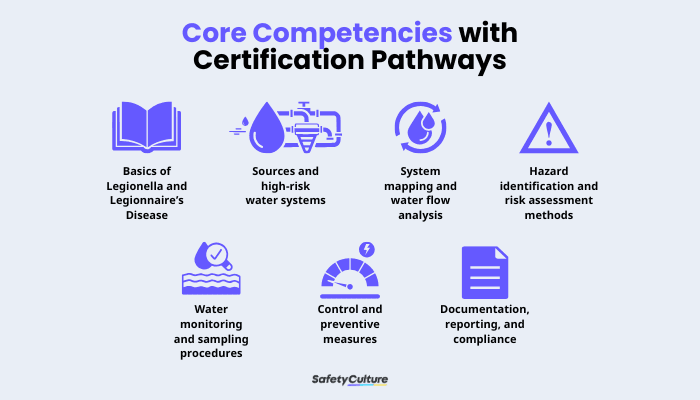
Personnel should learn about the biology, transmission, and health effects of Legionella and Legionnaires’ disease. Understanding the organism and how infections occur helps workers recognize the severity of the exposure and take prevention seriously.
Water Safety & Legionella Awareness Courses
Identifying systems where Legionella commonly grows allows organizations to prioritize monitoring and maintenance before contamination spreads.
Workers should learn to map plumbing systems and analyze water flow patterns. This helps them identify hidden hazards, such as stagnation zones, dead legs, and temperature conditions that encourage bacterial growth.
Risk assessments are the foundation of Legionella prevention programs. Personnel should be well-versed in structured methods for evaluating water systems, identifying vulnerabilities, and documenting risks that could lead to bacterial growth.
CLRA Training
Legionella Risk Assessment Professional Certification
Accurate sampling ensures early detection and helps prevent outbreaks. This course covers water temperature monitoring, microbiological sampling, and laboratory testing techniques used to detect Legionella contamination.
Environmental Monitoring
Water Hygiene Training
Practical control strategies, such as temperature management, system flushing, filtration, and chemical disinfection of water systems, prevent or reduce conditions that allow bacteria to multiply in water systems.
Legionella Control Program Manager Certification
Cooling Tower Maintenance
Water Disinfection or Treatment
Accurate records demonstrate compliance and support regulatory inspections or outbreak investigations. Everyone assigned to evaluate these biological hazards should take a Legionella risk assessment training course.
Uniform safety protocols often fail to account for complex water systems, a gap highlighted by the tragic 2025 Harlem outbreak. Resulting in 114 confirmed illnesses and seven fatalities, this case proves that inadequate monitoring has lethal consequences. Implementing a tiered expertise strategy can prevent such failures:
Training Level | Personnel Who Need Training | Learning Objectives |
Awareness Level | Frontline workers | This entry-level training teaches the basics: Basics of Legionella risks How it spreads through aerosolized water droplets Early warning signs of contaminated water systems |
Duty Holder Training | Responsible Person & Duty Holders | Business owners and health & safety officers should focus on: Legal responsibilities Regulatory compliance Risk management (water safety plans, monitoring programs, control procedures, documentation) |
Practical Risk Assessor Training | Facilities and site managers | Specific and technical knowledge on how to conduct risk assessments, including: System mapping Hazard identification Water sampling procedures |
Specialized Systems Level | Maintenance staff | Hands-on training, such as: Flushing procedures Temperature management Disinfection methods |
Refresher | Everyone involved in water safety programs | Staff should stay updated with the following: Regulations Emerging risks Improved control methods |
Build from scratch or choose from our collection of free, ready-to-download, and customizable templates.
Since the discovery of Legionella nearly 50 years ago, governments have developed standards to prevent Legionnaire’s disease through structured risk assessment, water management programs, and comprehensive training. Get to know some of the most consequential:
ACoP L8 (UK) - The Control of Legionella Bacteria in Water Systems outlines legal duties for employers and building owners to manage this bacterial hazard.
HSG274 (UK) - The Legionnaires’ Disease Technical Guidance supplements ACoP L8 by providing specific advice on controlling the bacteria in water systems and similar equipment.
HTM 04-01 (UK) - The Safe Water in Healthcare Premises upholds water safety management in healthcare facilities.
ASHRAE Standard 188 (US) - Legionellosis: Risk Management for Building Water Systems establishes requirements for water management programs in large or complex building water systems to control Legionella growth.
WHO Guidelines for Drinking-Water Quality - The WHO provides international recommendations for managing microbial risks in water systems, including Legionella.
SafetyCulture is a mobile-first operations platform adopted across industries such as manufacturing, mining, construction, retail, and hospitality. It’s designed to equip leaders and working teams with the knowledge and tools to do their best work—to the safest and highest standard.
Deploy expert-led Legionella courses or build custom, bite-sized modules with quizzes from scratch to deliver targeted knowledge. Bridge the gap between theory and field execution by integrating digital checklists during practice monitoring. Centralizing course data and certifications ensures seamless compliance. Empower duty holders and responsible persons to identify and mitigate Legionella hazards effectively through a unified platform.
✓ Save and reduce costs
✓ Stay on top of risks and incidents
✓ Boost productivity and efficiency
✓ Enhance communication and collaboration
✓ Discover improvement opportunities
✓ Make data-driven business decisions
In this article