What is a Teacher Observation Form?
A teacher observation form is a structured document used to evaluate and document a teacher’s classroom performance. It is typically completed by school administrators, instructional coaches, department heads, or peer reviewers during classroom observations.
The purpose of a teacher observation form is to assess instructional effectiveness, classroom management, student engagement, and overall teaching practices. It supports professional development, performance evaluations, and continuous improvement in educational settings.
Teacher observation forms are commonly used in K–12 schools, higher education institutions, and training organizations.
Importance
Utilizing ready-to-fill teacher observation forms is primarily used to efficiently document classroom performance in a structured and standardized manner. These forms simplify the evaluation process by providing clear criteria, reducing subjectivity, and ensuring consistency across observations. Additionally:
Promotes consistency- Using a structured form ensures all teachers are evaluated based on the same criteria.
Encourages professional growth- Constructive feedback helps teachers identify strengths and areas for improvement.
Improves student outcomes- Better teaching practices lead to higher student engagement and achievement.
Provides documentation- Observation forms create an official record that can support performance reviews and HR processes.
What to Include in a Teacher Observation Form?
A well-designed teacher observation form template should capture both objective data and qualitative feedback. Key sections typically include:
General Information
Teacher’s name
Subject/grade level
Date and time of observation
Observer’s name
Lesson Objectives
Clear learning goals
Alignment with curriculum standards
Measurable outcomes
Instructional Delivery
Clarity of explanations
Use of teaching strategies
Differentiation for diverse learners
Use of instructional materials and technology
Classroom Management
Student behavior management
Classroom organization
Transitions between activities
Student Engagement
Participation levels
Questioning techniques
Student collaboration
Responsiveness to feedback
Assessment and Feedback
Formative assessment methods
Monitoring student understanding
Feedback provided during the lesson
Strengths and Areas for Improvement
Observed strengths
Suggested improvements
Action steps
Including these components ensures the observation is structured, consistent, and focused on instructional quality.
How to Fill Out a Teacher Observation Form
The goal is to provide constructive, evidence-based feedback that supports professional growth and instructional improvement.
Follow these steps to complete a teacher observation form effectively:
Step 1: Review the observation criteria before the visit
Before entering the classroom, familiarize yourself with the evaluation standards and performance indicators on the form. Understand what each category measures, such as instructional delivery, classroom management, or student engagement.
This ensures your observations align with the school’s expectations and evaluation framework.
Step 2: Record basic information
Start by completing the general details section, including:
Teacher’s name
Observer’s name
Subject and grade level
Date and time of observation
Duration of observation
Accurate documentation is important for record-keeping and follow-up discussions.
Step 3: Observe objectively and take evidence-based notes
During the observation: focus only on what you see and hear, avoid assumptions or personal opinions, and write specific examples of teacher and student behaviors
For example, instead of writing“Students were engaged,”write: “12 out of 15 students actively participated in the group discussion and responded to questions.” Specific evidence strengthens the reliability of the evaluation.
Step 4: Provide constructive comments
Use the comments section to highlight strengths, identify areas for improvement, and offer actionable recommendations. Balance positive feedback with growth opportunities.
Step 5: Assign an overall rating (if required)
If the form includes a rating scale (e.g., Excellent, Proficient, Needs Improvement), ensure your rating aligns with the evidence recorded in your notes. Avoid rating inconsistencies that are not supported by your observations.
Best Practices for Conducting Teacher Observations
Be objective and evidence-based. Focus on observable behaviors, not personal opinions.
Provide actionable feedback. Offer specific suggestions for improvement.
Schedule pre- and post-observation meetings. Discuss goals beforehand and feedback afterward.
Use digital forms when possible. Digital observation forms allow real-time documentation and easier reporting.
Encourage self-reflection. Allow teachers to evaluate their own performance as part of the process.
Teacher Observation Form Example
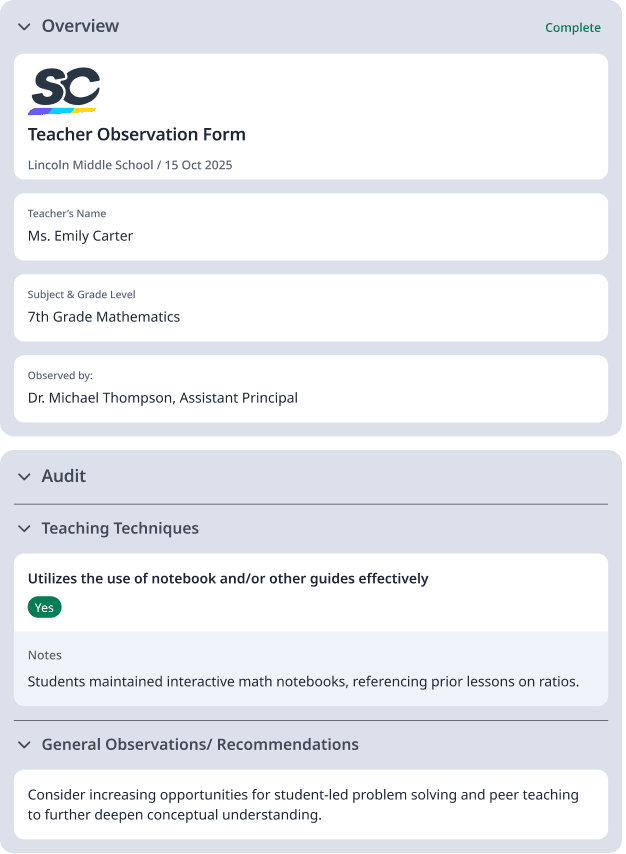
Here's an example of a filled-out teacher observation form:
Basic Information
School: Lincoln Middle School
Teacher's Name: Ms. Emily Carter
School Year: S.Y. 2025 – 2026
Subject & Grade Level: 7th Grade Mathematics
Conducted on: October 15, 2025
Observed by: Dr. Michael Thompson, Assistant Principal
Teaching Techniques
Utilizes the use of notebook and/or other guides effectively: Yes
Note: Students maintained interactive math notebooks, referencing prior lessons on ratios and unit rates.
Demonstrates sufficient mastery of content: Yes
Note: Ms. Carter confidently explained complex concepts and addressed student questions accurately.
Makes effective use of a variety of available materials: Yes
Note: She used the Smartboard for modeling problems, manipulatives for hands-on learning, and real-world word problems to reinforce understanding.
Makes clear, practical demonstrations: Yes
Note: The teacher modeled solving multi-step proportional problems step-by-step before releasing students to guided practice.
General Observation / Recommendations
Ms. Carter demonstrates strong instructional planning and classroom management skills. The lesson objectives were clear, and students were actively engaged in learning.
Recommendation: Continue incorporating differentiated instruction strategies. Consider increasing opportunities for student-led problem-solving and peer teaching to deepen conceptual understanding further.