Role
The role of an environmental aspects and impacts register is multifaceted and pivotal in environmental management within organizations. Specifically, using a register template can help in the following:
Comprehensive Documentation and Analysis
It serves as a repository for documenting and analyzing the various environmental aspects and impacts associated with the overall business operations. By systematically identifying and assessing these aspects and impacts, the register enables organizations to prioritize actions and allocate resources effectively to mitigate or eliminate adverse effects.
Crucial Role in Regulatory Compliance
Using an environmental aspects and impacts register also helps organizations adhere to relevant laws and regulations. The tool allows them to maintain accurate and up-to-date records of their environmental performance, demonstrate their commitment to environmental stewardship, and ensure transparency to regulatory authorities.
Fundamental for Environmental Management Systems (EMS)
The International Organization for Standardization’s ISO 14001 is an internationally recognized standard for establishing, implementing, maintaining, and improving an organization’s environmental management practices.
To easily identify and evaluate key environmental aspects, which is an essential component of the ISO standard, using a register serves as a fundamental tool for fulfilling the standard’s requirements and maintaining conformance. Additionally, it also helps with regulating and organizing data from environmental monitoring sensors, further assisting in managing compliance and improving EMS in place.
What to Include in This Template
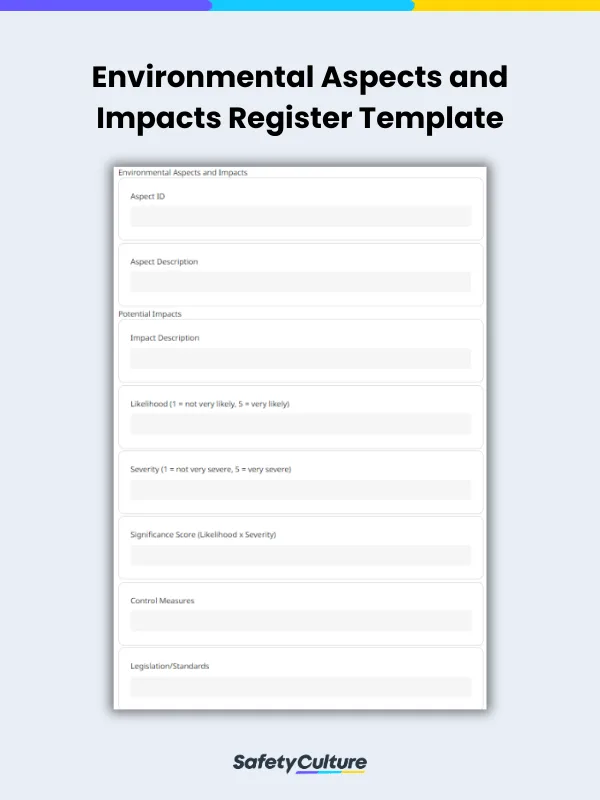
To help make the template easier to fill out, a basic environmental aspects and impacts register template must feature the following items and sections:
Title Page
Environmental Aspects Identification and Impacts Assessment
Severity and Likelihood Assessment
Significance Score
Control Measures and Legislation/Standards
Completion Page
How to Create and Use an Environmental Aspects and Impacts Register
Generally, you may follow these steps to effectively establish and implement a streamlined process of using this register template:
Define the scope and boundaries of the register, outlining the activities, products, and services to be included.
Identify relevant environmental aspects associated with the organization’s operations, considering inputs, outputs, and interactions with the environment.
Evaluate the significance of each environmental aspect based on their severity and likelihood, assigning scores accordingly.
Assess the potential environmental impacts associated with significant aspects, considering their magnitude and extent.
Develop control measures and mitigation actions to minimize or eliminate adverse environmental impacts, specifying responsible parties and timelines.
Review and update the register regularly to reflect changes in operations, regulations, and stakeholder expectations.
Communicate the contents of the register to relevant stakeholders, ensuring transparency and accountability in environmental management practices.
Environmental Aspects and Impacts Register Example
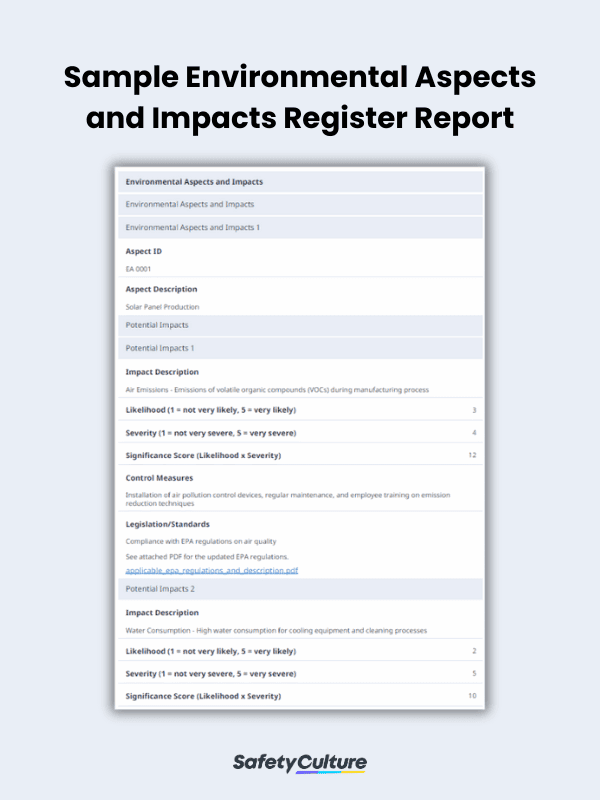
Here’s a sample of a filled-out environmental aspects and impacts register template when exported as a report:
Sample Environmental Aspects and Impacts Register | SafetyCulture