Importance and Benefits of a Risk Retention Register Template
Risk retention without documentation is just untracked exposure. When an organization decides to accept a risk and doesn't record it, there's no way to confirm the decision was intentional, no owner to monitor it, and no trigger to review it if circumstances change.
Turns informal decisions into auditable records: Every risk retention decision involves a judgment call, whether the cost of insurance outweighs the likely loss, or that a risk is simply uninsurable. A register captures the reasoning, the date, and the decision-maker, giving auditors and stakeholders evidence that the organization is managing risk actively, not passively.
Prevents retained risks from going stale: Regulatory changes, shifts in business scale, or new exposure data can affect risks. With review dates and ownership recorded, retained risks get revisited instead of sitting indefinitely on an assumption that's no longer valid.
Supports reserve and budget planning: Organizations that retain risks often set aside financial reserves or self-insurance funds to cover potential losses. A register makes it possible to see the full picture of retained exposure in one place — and to tie that figure to financial planning decisions.
Strengthens accountability: Named ownership means someone is responsible for monitoring each retained risk and escalating when conditions change. Without it, retained risks tend to be everyone's problem in theory and no one's problem in practice.
Supports broader risk reporting: Retained risks don't sit outside the risk management program — they're part of it. A well-maintained retention register connects directly to risk reporting for boards, senior leadership, and compliance functions that need a complete picture of the organization's total risk exposure.
What to Include in a Risk Retention Register Template
An effective risk register template provides the core structure for logging retained risks. It should capture the following:
Company and project details
Start with the basics: organization name, date of creation, and the name of the person completing the register. For project-specific retention decisions, include the project name and project manager. This context matters when the register is reviewed months later or used as evidence during an audit.
Risk ID and description
Assign each retained risk a unique identifier and write a straightforward description of the specific scenario. Don't simply record "operational risk". Instead, specify something like "delivery vehicle fleet not insured against minor collision damage below $5,000, covered through internal reserves." The specificity is what makes the record useful when the risk eventually needs to be re-evaluated.
Risk category
Identify each entry by category — operational, financial, legal and compliance, reputational, environmental, or other categories relevant to the business. Categorizing retained risks makes it easier to run aggregate reviews across risk types and spots where retention is concentrated.
Likelihood and impact ratings
Rate each retained risk for how probable it is to occur and what the consequences would be if it did. Most organizations use a 1–5 scale or Low/Medium/High labels. These ratings are what justify retaining the risk in the first place — a risk worth retaining typically sits low on one or both dimensions — and they're what should trigger a review if either dimension shifts.
Rationale for retention
Record why the organization chose to retain this risk. Specify the expected loss and other associated issues that could arise if the identified risk is not retained. Without this field, there's no way to tell later whether a retained risk was intentional or simply missed.
Current controls and reserve arrangements
Document what's already in place to absorb the retained risk. This might include financial reserves set aside to cover losses, deductible arrangements on existing policies, internal process controls that reduce exposure, or contingency plans that would activate if the risk occurs.
Recommendations and review date
Record any additional steps recommended before the next review cycle, and set a concrete review date. Retained risks should be revisited at least annually and immediately when business conditions change materially. This is also where photos, supporting documents, or notes can be attached using SafetyCulture to build a richer, evidence-backed record.
How to Use a Risk Retention Register Template
It’s crucial to know how to use this template properly to effectively register and monitor risks. Here’s a quick guide:
Run a risk assessment first. The retention register is downstream of risk assessment — you can only decide to retain a risk once you've identified and scored it. Complete your risk identification process before populating the register, so every entry reflects a deliberate decision rather than a gap in coverage.
Document the retention decision clearly. For each retained risk, record the reasoning. A cost-benefit comparison works well here: if the annual insurance premium for a risk is $8,000 and expected annual losses are $2,000, the case for retention is clear and that logic belongs in the register.
Assign ownership before the register goes live. Every entry needs a named owner before the register is used for monitoring. Assign corrective actions easily and include annotations to give the full picture of responsibility.
Set realistic review dates. Low-rated retained risks might warrant an annual review. Higher-rated ones — risks accepted because they're currently uninsurable, for example — should be reviewed more frequently. Use SafetyCulture to schedule review reminders and assign follow-up actions directly from the register.
Connect the register to financial planning. Add up the total potential loss exposure from all retained risks and cross-reference with reserve funds. If retained exposure has grown beyond what internal reserves can absorb, that's a signal to revisit the retention decisions or expand insurance coverage.
Update on trigger events, not just review dates. When the organization grows, enters a new market, onboards a significant new supplier, or faces a regulatory change, revisit the relevant entries immediately. A retention decision made for a company generating $10 million in revenue may not hold at $50 million.
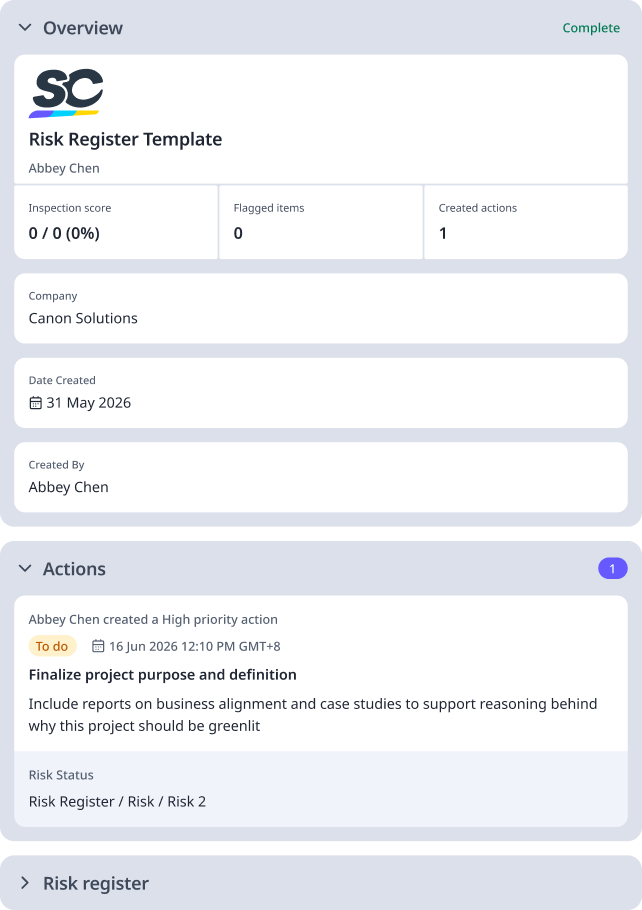
For reference, here is an example of a filled out risk retention register template:
Preview Sample Risk Retention Register PDF Report