Published 15 Jun 2026
Article by
5 min read
What is an ESG Risk Register Template?
An ESG risk register template is a structured document that records every identified environmental, social, and governance risk an organization faces, along with how those risks are rated, who owns them, and what's being done to address them. It's the central record that connects ESG strategy to operational accountability.
The template brings order to a risk landscape that spans three distinct pillars and touches every part of the business, from facilities and supply chains to board oversight and investor reporting.
Importance and Benefits of an ESG Risk Register Template
ESG risk is no longer a peripheral concern. In 2025, more boards formally expanded their ESG oversight responsibilities and risk factor sections in annual filings grew to include physical climate risks, transition risks, and supply chain dependencies, according to research from Donnelley Financial Solutions. Here is how an ESG risk register template can help:
Consolidated visibility: Environmental, social, and governance risks often land with different teams. A register pulls them into one record, making it easier to spot interdependencies and report consistently across all three pillars.
Audit-ready documentation: Frameworks like the EU's Corporate Sustainability Reporting Directive (CSRD), the Global Reporting Initiative (GRI), and the Task Force on Climate-related Financial Disclosures (TCFD) all require structured evidence of ESG risk identification and ongoing management. A maintained register satisfies that requirement without reconstructing the paper trail before each reporting cycle.
Investor and stakeholder confidence: The EU's ESG rating activity regulation reflects growing investor demand for reliable, comparable ESG risk data. A register gives organizations concrete evidence to share documented controls and response plans for every material risk.
Faster decisions when it matters: When an ESG event occurs like a regulatory change, a supply chain incident, a climate impact, the register shows what was already flagged, what controls existed, and who was responsible. That context shortens response time.
Clear accountability: Every entry has a named owner and a review date. When responsibility is documented, ESG risks are far less likely to be acknowledged in strategy sessions but ignored in daily operations.
What to Include in an ESG Risk Register Template
The value of the register depends on consistency. These are the fields every entry should capture:
ESG pillar and risk category
Assign each risk to its primary pillar (Environmental, Social, or Governance) and a more specific category within that pillar.
Environmental categories typically include climate risk, water use, biodiversity, and emissions.
Social categories cover labor practices, health and safety, supply chain human rights, and community impact.
Governance categories include executive accountability, board oversight, anti-corruption controls, and data privacy.
Categorizing risks this way makes it easier to run pillar-level analyses and align entries to specific reporting framework requirements.
Risk description
Include a specific description for risks. Not just "climate risk" but something like "increased frequency of extreme weather events disrupts raw material supply from Tier 2 suppliers in Southeast Asia." The description should be specific enough that anyone reading it, including an external auditor, understands the exposure without needing to ask follow-up questions.
Likelihood and impact ratings
Rate each risk on likelihood and impact. Most organizations use a 1–5 scale or Low/Medium/High labels. Multiplying the two scores produces a risk rating that makes it possible to rank entries objectively and focus attention where it's most needed.
Risk owner
Name a specific individual responsible for monitoring and managing each risk. Assigning ownership to a team or department dilutes accountability. The owner is responsible for keeping the entry current, escalating when the risk profile changes, and implementing the agreed mitigation plan.
Current controls
Document what's already in place to reduce the likelihood or impact of the risk. For an emissions-related risk, this might include existing energy monitoring systems, supplier contracts with carbon reduction clauses, or ISO 14001 certification. Recording current controls prevents duplication of effort and surfaces gaps where coverage is weaker than assumed.
Treatment and mitigation plan
Record the chosen response: accept, avoid, transfer (for example, through insurance or contract terms), or mitigate. Where mitigation is the approach, document the specific actions required, who's responsible for each, and the target completion date.
How to Use an ESG Risk Register Template
To maximize the benefits of using this template, it’s important to know how to use it correctly. Here is a step-by-step guide:
Identify which ESG issues affect the business financially and which issues affects communities and the environment. Log it in the checklist.
Rate each risk for likelihood and impact, then sort by score. The scoring should reflect your actual business — a manufacturer's physical climate risks look very different from a financial services firm's governance exposures.
Every entry needs a named individual and a response deadline. Platforms like SafetyCulture let teams assign corrective actions directly from the register and generate audit-ready reports, cutting the manual overhead of spreadsheet-based tracking.
Schedule a baseline quarterly review, and update entries immediately when regulation changes, a significant incident occurs, or the business adds a new geography or supplier tier.
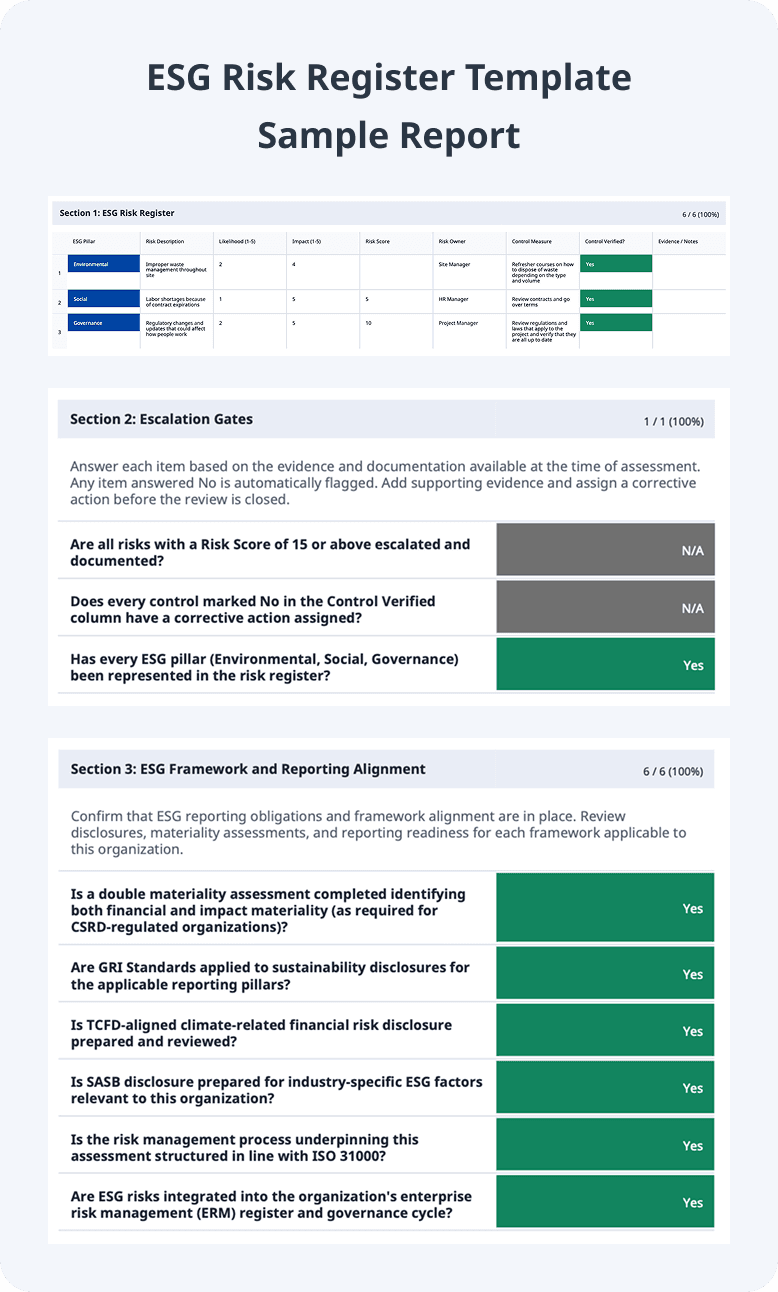
Sample ESG Risk Register
For reference, here is a filled-out ESG risk register template:

Still looking for a checklist?
Search, filter, and customize 60,000+ templates across industries and use cases.