Published 9 Jun 2026
Article by
7 min read
What is an ESG Risk Management Checklist?
An ESG risk management checklist is a structured tool for identifying, assessing, and tracking the environmental, social, and governance risks that affect an organization. Unlike a general ESG checklist focused on measuring performance, this tool is built for risk work to help teams spot exposures, rate their severity, assign ownership, and document the controls that keep them in check.
What an ESG Risk Management Checklist Should Include
The depth of your checklist will depend on your industry, size, and the frameworks you report against, but an effective ESG risk management checklist covers these core three pillars.
Environmental risk items
Greenhouse gas emissions
Energy consumption and efficiency targets
Water usage and discharge
Waste generation, disposal, and recycling rates
Climate-related physical risks (flooding, extreme heat, supply disruption)
Transition risks from policy changes or low-carbon regulation
Land use, biodiversity impact, and ecological footprint
Social risk items
Fair wages, working hours, and labor compliance
Health and safety incident rates and near-miss reporting
Supply chain labor standards and modern slavery exposure
Employee wellbeing, turnover, and engagement
Community impact and stakeholder relations
Human rights due diligence across operations and suppliers
Governance risk items
Board composition, diversity, and independence
Anti-bribery and corruption controls
Data privacy and cybersecurity protocols
Financial reporting accuracy and disclosure practices
Executive compensation transparency
Crisis management and whistleblowing mechanisms
A realistic checklist doesn't require 200 line items. Swiss Re's ESG risk screening screened over 125,000 transactions in 2024 alone, flagging nearly 5,000 companies for enhanced monitoring, which shows just how operationally demanding unmanaged ESG risk can be. The value of the checklist is in getting systematic about which risks apply to a specific business, not in covering every conceivable scenario.
How to Use the ESG Risk Management Checklist
Downloading the template is the easy part. The harder work — and where most organizations stall — is turning it into an active risk management tool rather than a document that gets filed and forgotten.
Here's a four-step process that puts the checklist to work:
Step 1: Map your material ESG risks
Start with the ESG risks most relevant to your industry and business model. "Materiality" in ESG terms means the issues that are financially significant to your organization and the issues where your operations have the most impact on the world.
ISO 31000:2018 provides the foundational risk management framework for this kind of structured identification and context-setting. Use it alongside your checklist to ensure you're not just listing risks but understanding which ones require urgent attention.
Step 2: Assess likelihood and impact
Score each identified risk by how likely it is to occur and how severe the consequences would be. A risk matrix helps you visualize this — placing risks on a grid from low-likelihood/low-impact to high-likelihood/high-impact.
This prioritization step is what separates an ESG risk management checklist from a simple ESG audit: you're deciding what to act on first, not just recording what exists.
Step 3: Assign ownership and define controls
Every high-priority risk needs an owner. This is where ESG risk management connects to your ERM process — the same person or team accountable for a governance risk on your ESG checklist should be the same person accountable for it in your wider risk register. Define the control measure (policy, process, monitoring system) and record it against each item.
Step 4: Document evidence and set a review cadence
Regulators and investors increasingly want auditable evidence, not assertions. Build your checklist so every item has an evidence field and a place to log the audit record, policy document, or sensor data that proves the control is working. Review the checklist at least annually, and after any significant operational change.
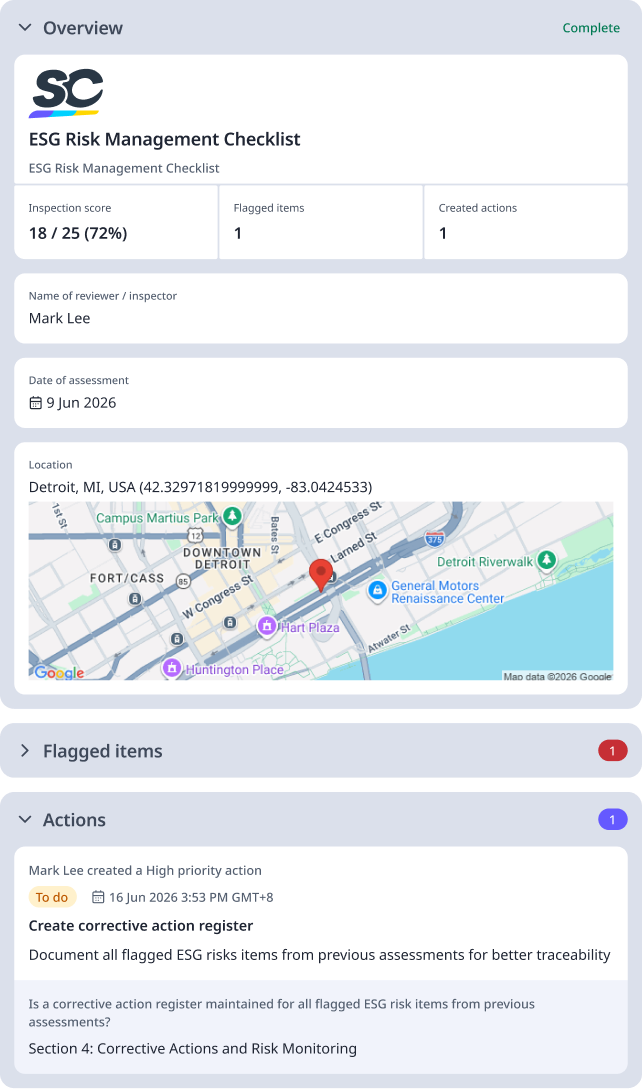
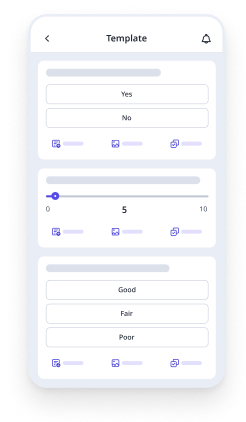
Platforms like SafetyCulture make this process easier to sustain at scale. Teams can run ESG risk assessments using digital checklists, assign corrective actions in real time, and generate audit-ready reports without chasing spreadsheets across departments.
For reference, here is an example of a filled out ESG risk management checklist:
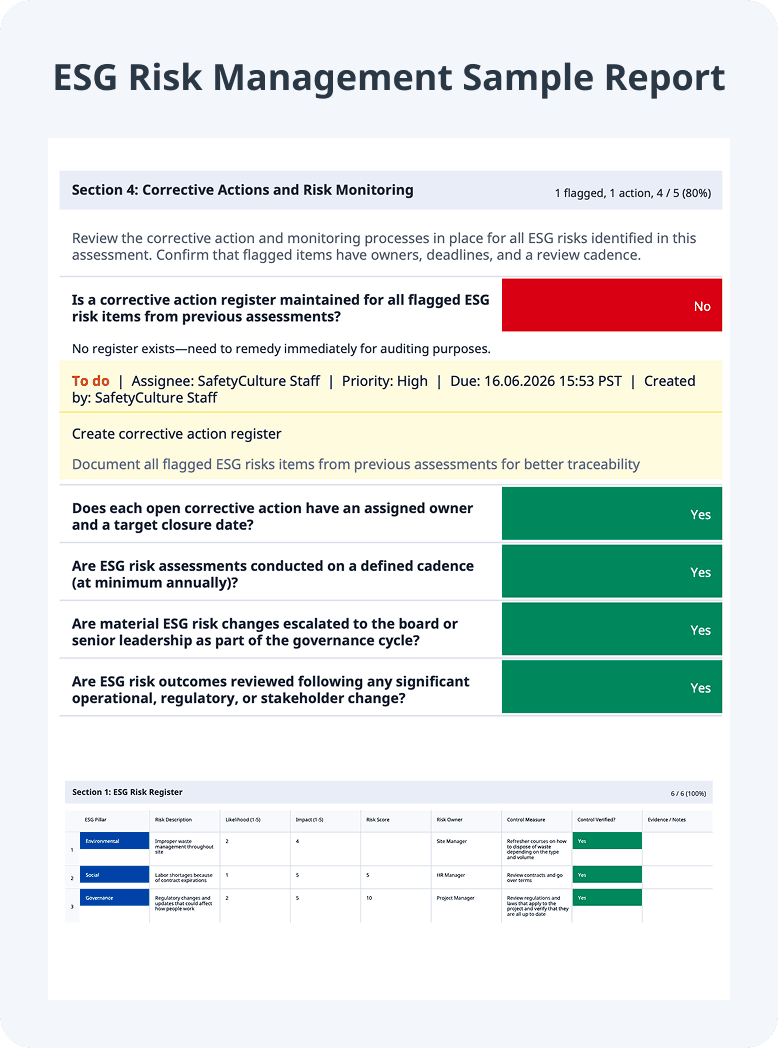
Preview Sample ESG Risk Management Checklist PDF Report
ESG Risk Frameworks Your Checklist Should Align With
You don't need to build your ESG risk management checklist from scratch. Several established frameworks define what to measure and how to disclose it. The right one for your organization depends on your industry, size, and where you operate.
Framework | What it covers | Who it's most relevant for |
GRI (Global Reporting Initiative) | Broad sustainability disclosures across all ESG pillars | Any organization reporting publicly on sustainability |
SASB (Sustainability Accounting Standards Board) | Industry-specific ESG disclosure standards | Companies with investor-facing ESG reporting |
TCFD | Climate-related financial risks and opportunities | Companies with significant climate exposure |
EU CSRD | Mandatory ESG reporting with double materiality | Large companies operating in or with the EU |
ISO 14001 | Environmental management systems | Any organization managing environmental risks |
ISO 31000 | Risk management principles and framework | Any organization integrating ESG into ERM |
ISO 26000 | Social responsibility guidance | Organizations assessing social and governance risks |
If you're EU-based or supply into EU markets, CSRD compliance is no longer optional for large organizations — it requires reporting on how ESG issues affect your business and how your business affects the environment and society (the "double materiality" requirement). If you primarily answer to institutional investors, SASB and TCFD alignment gives them the comparable data they need for their own ESG risk ratings. For most mid-market companies, starting with ISO 31000 as the risk management backbone and layering in GRI for disclosure is a practical starting point.
The goal isn't to satisfy every framework at once. It's to build a checklist structure that can be adapted as your reporting obligations evolve.
ESG Risk Management by Industry: What to Prioritize
ESG risks don't look the same across industries. A manufacturing company faces very different exposures than a financial services firm — and a checklist that doesn't reflect those differences will miss the issues that matter most to your stakeholders and regulators.
Here's how the priority items shift by sector:
Manufacturing
Supply chain emissions typically dominate ESG risks in manufacturing, alongside worker safety incident rates, waste and effluent from production, and sourcing of raw materials from high-risk regions. For manufacturers certified to ISO 14001 or ISO 45001, the ESG checklist should map directly onto their existing management system audits.
Financial services and banking
ESG risks for banks sit primarily in their loan books and investment portfolios — credit risk from borrowers exposed to climate transition costs, governance failures in financed companies, and social lending practices. KPMG noted that most banks have built foundational ESG governance structures but still have work to do embedding climate risk into their capital modeling and data frameworks.
Construction
Environmental impact on site (disturbed land, waste, noise), contractor labor compliance across long subcontractor chains, and safety governance are the main ESG exposures. The checklist should include site-level environmental checks alongside the contractor due diligence processes that sit in the governance pillar.
Retail
Supply chain labor standards — particularly in sourcing countries — sit at the top of the social risk list for retailers. ESG risks also include packaging and waste footprint, board diversity at the governance level, and increasingly, the carbon intensity of logistics and returns operations.
Knowing which risks are highest-stakes for your sector helps you weigh your checklist correctly. You'll document all three pillars, but you'll prioritize differently when it comes to controls, monitoring frequency, and the evidence you collect for auditors.
Still looking for a checklist?
Search, filter, and customize 60,000+ templates across industries and use cases.