What to Include in a Cybersecurity Risk Management Checklist
A well-structured cybersecurity risk management checklist covers five core areas: assets, threats, vulnerabilities, risk scores, and treatment actions.
Asset identification and scoping
Before a team can assess any cybersecurity risk, it needs a complete picture of what it's protecting.
Assets to document in this phase include:
Hardware: servers, endpoints, mobile devices, IoT equipment
Software: operating systems, licensed applications, SaaS tools
Data: customer records, financial data, intellectual property, credentials
Cloud infrastructure: cloud storage, hosted services, virtual machines
Third-party connections: vendors, contractors, and partner integrations
It's a living asset register that gets updated when new systems are added, vendors are onboarded, or infrastructure changes. Organizations running a risk assessment process for the first time often find the asset register is the most time-consuming part. It's also the most valuable.
Threat and vulnerability assessment
With assets documented, the next checklist section identifies what could go wrong for each one. Threats fall into two categories: external and internal.
External threats to capture:
Phishing and social engineering attacks
Ransomware and malware
Distributed denial-of-service (DDoS) attacks
Third-party and supply chain compromises
Credential theft and account takeover
Internal threats to capture:
Misconfigured systems or access controls
Unpatched software and known vulnerabilities
Accidental data exposure by employees
Excessive user privileges
For each threat, the checklist should record the affected asset, the vulnerability being exploited, any existing controls, and whether those controls are sufficient. NIST CSF 2.0 maps this to its "Identify" and "Protect" functions — so if your organization is working toward NIST alignment, your threat and vulnerability section is doing double duty.
Risk scoring and prioritization
Once threats and vulnerabilities are documented, each risk gets a score. The standard approach is a likelihood-impact matrix: rate the probability of the threat occurring (rare to near-certain) and the potential impact if it does (low to critical), then multiply the two scores to produce a risk rating.
The result tells you where to spend your remediation budget first. A risk analysis framework like the 5×5 matrix gives you five levels for both probability and impact, producing 25 possible combinations, color-coded from green (low) to red (critical). Teams that use this approach consistently find that a small number of high-rated risks account for most of their actual exposure.
Risk treatment actions then follow from the score:
Mitigate: implement a control to reduce likelihood or impact
Accept: document the risk and monitor it; no action taken
Transfer: shift the risk through insurance or a third-party agreement
Avoid: eliminate the activity or asset that creates the risk
How to Use a Cybersecurity Risk Management Checklist
The checklist isn't just a document, but part of the process for ensuring effective cybersecurity risk management.
Set the scope: Define which systems, locations, and business units are in scope for this assessment cycle
Complete the asset register: Document all in-scope assets, their owners, and their data classification
Identify threats and vulnerabilities: For each asset, document relevant threats and any known weaknesses
Score each risk: Apply the likelihood-impact matrix and assign a risk rating
Assign treatment actions: For every risk rated medium or above, document the treatment decision, the owner, and a completion date
Record findings: Log everything in the risk register, including evidence of existing controls
Schedule the next review: Set a date and note any trigger conditions that would prompt an earlier review
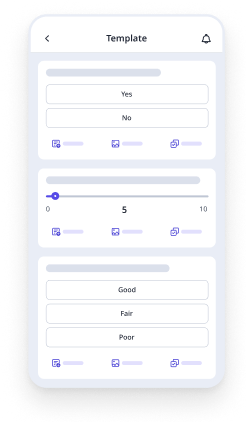
Platforms like SafetyCulture let teams run this workflow digitally to capture risk data against a customizable checklist template, assign corrective actions to owners, and generate audit-ready reports automatically.
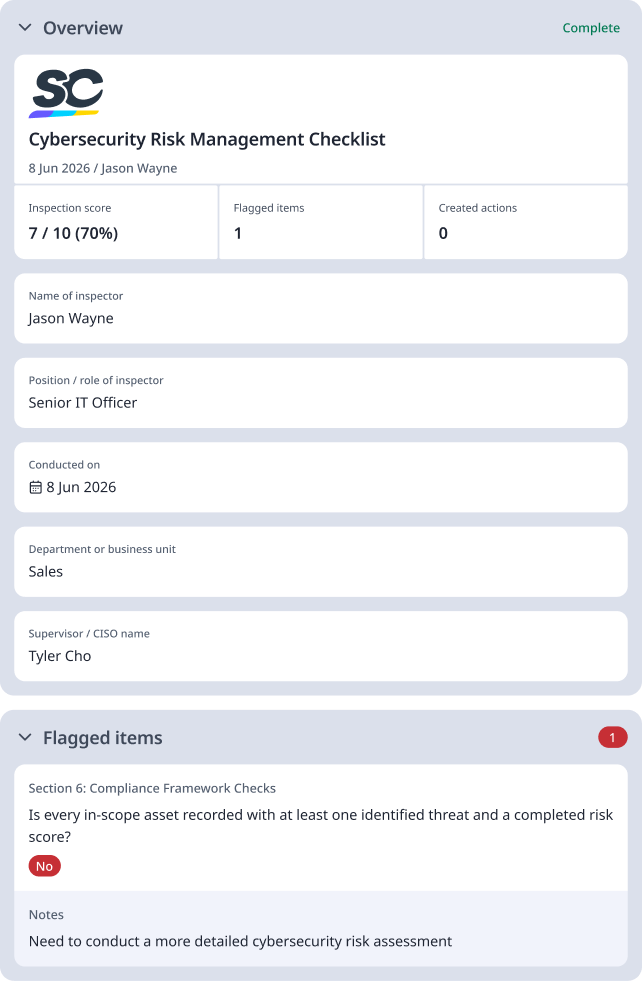
For reference, here is an example of a filled out cybersecurity risk management checklist:
Preview Cybersecurity Risk Management PDF Report
Aligning Your Checklist With Compliance Frameworks
A cybersecurity risk management checklist doesn't replace a compliance framework — it implements one. The two most widely referenced frameworks for structuring a checklist are ISO/IEC 27001:2022 and NIST CSF 2.0.
ISO/IEC 27001 sets out the requirements for an Information Security Management System (ISMS). Its companion standard, ISO/IEC 27005, goes deeper on risk management specifically — covering risk identification, analysis, evaluation, and treatment. If your organization is working toward ISO 27001 certification, your checklist is the operational evidence that your risk management process is running.
NIST CSF 2.0 organizes cybersecurity activities into six functions: Govern, Identify, Protect, Detect, Respond, and Recover. A well-structured checklist maps naturally to the first three: identifying assets and threats (Identify), documenting controls (Protect), and establishing governance through ownership and review schedules (Govern).
For organizations in regulated industries, additional requirements layer on top:
FINRA (financial services) requires firms to maintain a cybersecurity checklist addressing access controls, data loss prevention, and incident response
HIPAA (healthcare) requires a formal security risk analysis as part of its Security Rule
PCI-DSS (payment cards) mandates regular risk assessments for systems that store or process cardholder data
GDPR (EU) requires organizations to assess risks to personal data and implement appropriate controls
The checklist doesn't need separate versions for each framework. One well-structured document, mapped to ISO 27001 or NIST CSF as the backbone, will satisfy the overlapping requirements of most sector-specific regulations.