Importance and Benefits
Substances such as dust, gases, fumes, liquids, gels, and powders can easily cause harm when they come into contact with human skin or are breathed in. This leads to chronic effects such as infections, allergies, and long-term conditions like lung disease or occupational asthma that cannot be cured once they develop.
As a result, controlling hazardous substances at work is a legal requirement under the COSHH Regulations 2002.A COSHH register template helps you meet that requirement in a structured, repeatable way. Here's why it matters:
Protects worker health and safety: A COSHH register gives everyone in the workplace clear, accessible information about the hazardous substances they may encounter and the precautions they need to take.
Supports legal compliance: The law requires employers to adequately control exposure to materials in the workplace that cause ill health. A well-maintained COSHH register is one of the key ways to demonstrate that you're meeting those obligations during an HSE inspection.
Enables faster, more accurate risk assessments: By centralizing substance information in one place, a COSHH register makes it easier to assess risks, identify gaps in control measures, and link entries to the relevant Safety Data Sheets (SDS).
Supports incident investigations: If an accident or near-miss involving a hazardous substance occurs, the register can help identify what went wrong, whether control measures were adequate, and what corrective actions are needed.
Improves communication across teams: When shared properly, a COSHH register ensures that health and safety professionals, managers, and employees are all working from the same information. This reduces the risk of something important being missed.
Makes continuous improvement easier: A templated format means your records are consistent and reproducible. This makes it simpler to spot patterns, update entries when substances change, and build on your safety processes over time.
What to Include in a COSHH Register Template
Following the HSE's regulations, a COSHH register template should ideally contain fields for the following:
Location of workplace: The site or area where the hazardous substance is used or stored.
Name of the substance: Covers chemicals, fumes, dusts, vapors, mists, gases, and biological agents. Lead, asbestos, and radioactive substances fall under separate regulations.
Storage location: Where the substance is kept on-site, including any special storage conditions required.
Hazard sheets and SDS details: The location or reference details of the relevant Safety Data Sheets for each substance.
Hazard classification and risk level: The substance's hazard category and the level of risk it poses to workers.
Control measures in place: Ventilation equipment, safe working procedures, and supervision or training requirements for handling the substance.
PPE required: Respirators, gloves, clothing, footwear, or eye protection needed, and who is responsible for maintaining and replacing them.
Name of person preparing the template: The individual or team responsible for completing and maintaining the register.
For a more streamlined documentation process, these fields can be reproduced as needed for each substance. Managing yours on a digital platform keeps all records in one place, easy to access and update.
How to Complete a COSHH Register Template
Filling in a COSHH register is straightforward once you know what to look for. Here's how to work through it step by step.
Step 1: Identify all hazardous substances in your workplace
Start by identifying which substances are harmful by reading product labels and safety data sheets. Don't forget substances produced by your processes, such as dust from sanding, fumes from welding, or vapors from cutting.
Step 2: Gather the details for each substance
For each substance identified, record its name, storage location, hazard classification, and the location of its SDS. This is the core information your register needs to be useful during an inspection or incident investigation.
Step 3: Document control measures and PPE
Record the control measures in place for each substance. This includes ventilation equipment, safe working procedures, and any supervision or training requirements. Note the PPE required and who is responsible for maintaining it.
Step 4: Assign ownership and share the register
Record the name of the person responsible for completing and maintaining the register. Once complete, share it with the relevant managers and employees so everyone is working from the same information.
Step 5: Link entries to your risk assessments
Connect each register entry to its corresponding COSHH risk assessment template and SDS. This keeps your records audit-ready and makes it easier to identify gaps in your control measures over time.
Common Uses for a COSHH Register Template
According to the UK HSE, a COSHH register template form is often used for the following industries:
Paving companies and similar service providers
Die-casting providers and other similar companies
Electronics
Fruit farms
Warehousing
Feed mills
DIY shops, workshops, and similar service providers
Engineering
Gardening
Culinary
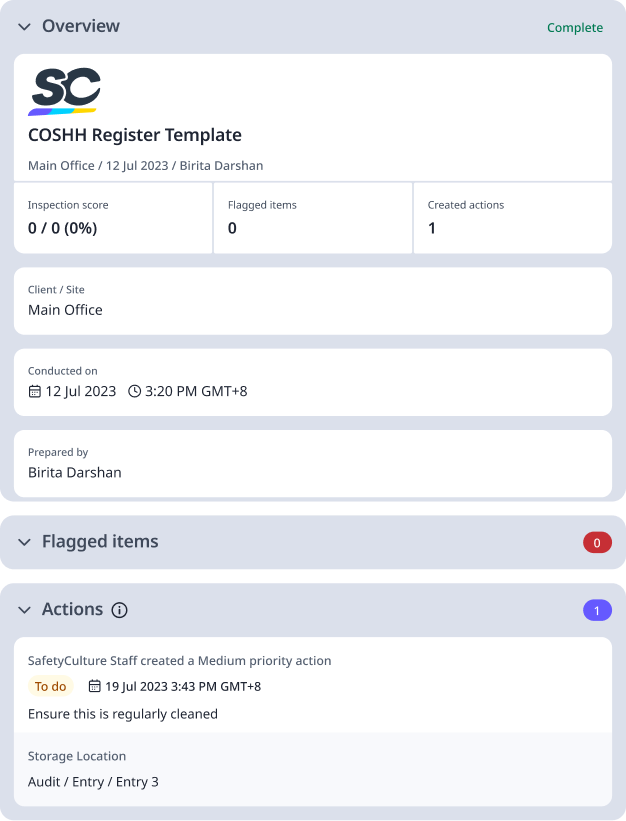
Sample COSHH Register Template Report
This sample report shows a completed COSHH register with all key fields filled in to give you an idea of how each part should be answered. We’ve provided the template for your reference below:
Preview COSHH Register Template Sample Report