Published 24 Jun 2026
Article by
4 min read
What is a Business Impact Analysis Template?
A business impact analysis (BIA) template is a structured document used to evaluate and document the potential negative impact on an organization in the event of an emergency disruption. It is used by management to measure the potential financial / operational loss and minimum recovery times of critical functions during outages. It is an important first step to help management prioritize which areas to establish business continuity planning for.
Importance
A business impact analysis template equips organizations to identify their most critical functions and prepare for the consequences of losing them. Having this checklist provides several key benefits:
Supports business continuity planning: It is one of the first steps in any business continuity plan, as it identifies which functions to prioritize for recovery. FEMA’s Continuity Guidance Circular states that having a recorded BIA is essential for understanding which functions are important and the impact of their loss on the organization.
Ensures compliance with regulatory standards: It’s a requirement under ISO 22301:2019, the international standard for Business Continuity Management Systems.
Reduces financial losses: Businesses can minimize critical-function downtime by setting recovery time objectives. This helps avoid operational disruptions, revenue losses, and emergency response expenses.
Strengthens decision-making: Using this template gives directors and senior managers a structured perspective of organizational vulnerabilities. It makes it easier to allocate recovery resources to functions where they matter most.
Defines roles and responsibilities: The templates list the persons responsible for each recovery action, preventing confusion during a crisis. It also decreases the time to activate recovery strategies.
What Should Be Included in a Business Impact Analysis Template?
A business impact analysis template records every detail needed to plan for, respond to and recover from any disruption. The sections below include the core components that make this template useful in a crisis:
Business function and impact details
This section documents the functions that are being assessed and the potential consequences when they go down: It includes:
Name and description of each critical business function
Type of disruption being assessed (natural disaster, cyberattack, power outage, loss of key personnel)
Financial and operational impact of the loss or disruption of the function
Recovery time and data objectives
This field provides the acceptable limits for downtime and data loss. This includes:
Recovery time objective (RTO) is the maximum time before a function needs to be restored
Recovery point objective (RPO) is the maximum acceptable data loss in a measured time
Contractual requirements for each RTO and RPO
Dependencies and resource requirements
It presents the factors that each function depends on. Inspectors should verify the following:
Internal dependencies (systems, teams, tools on which the function relies)
External dependencies (suppliers, service providers and third-party platforms)
Staffing numbers and levels required to maintain the function
Recovery strategies and actions
If a function fails, this section outlines the actions the organization will take. This includes:
Manual workarounds and alternative procedures
Backup system, alternate sites or emergency supplies available for each function
Estimated time to activate each recovery strategy
Roles and responsibilities
This section discusses the people responsible and accountable for activities. Some of these:
Name and contact details of the person responsible for each recovery action
Escalation procedures to follow if the primary contact is unavailable
Sign-offs of senior management after review and approval
How to Use this Checklist
To create a business impact analysis that effectively identifies critical operations and minimizes disruption impacts on your organization, follow these steps.:
Provide the necessary details on the title page. This usually includes the inspector's name, the date, and the facility's location.
Collect relevant business information, including details on the key functions, finances and personnel. Interview the senior management head to identify risks and assess the organization's functions.
Determine the RTO for each business function and set the RPO for acceptable data loss due to a disruption.
Document a manual continuity plan to assess the workaround procedures for critical functions that cannot work without key systems or services.
Evaluate the collected data to identify the short-term and long-term impacts, which will then be reviewed by business partners, stakeholders, and investors.
Complete the checklist with a sign-off.
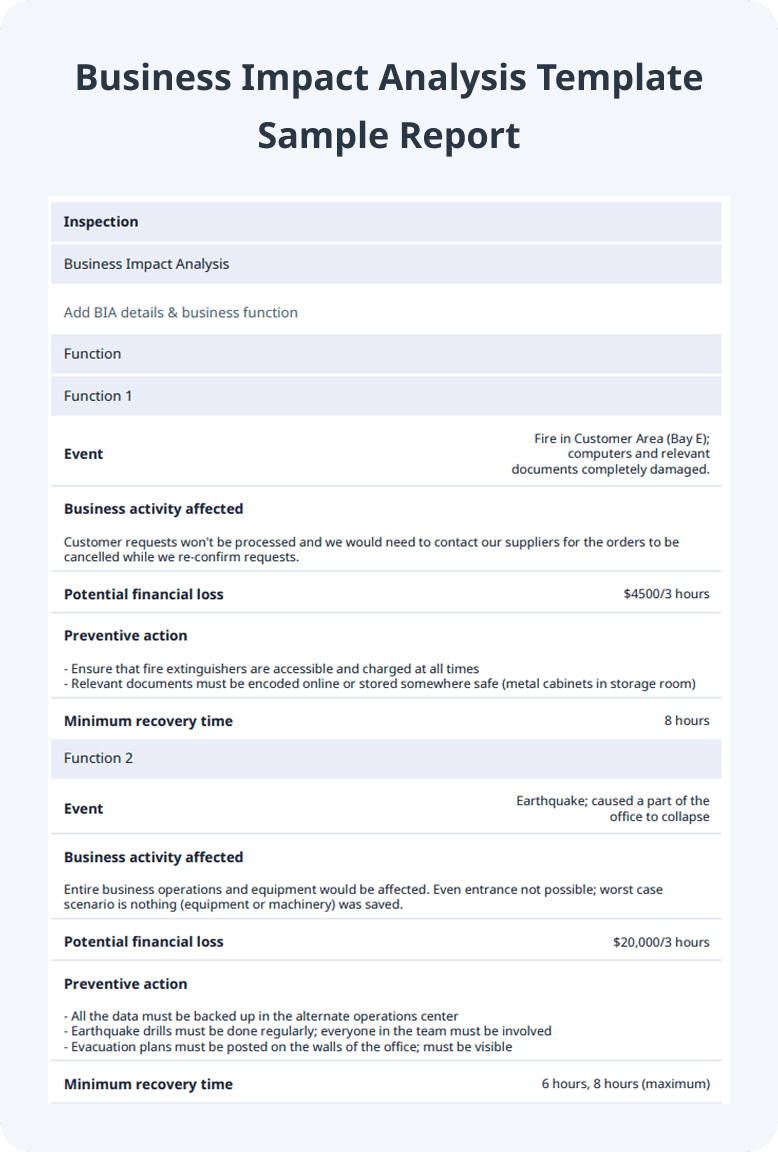
Sample Business Impact Analysis Report
For reference, here is a completed business impact analysis report:

Still looking for a checklist?
Search, filter, and customize 60,000+ templates across industries and use cases.