Building Safer Workplaces Through Risk Assessment Training
Learn how risk assessment training equips teams to identify hazards, evaluate risks, and implement effective controls to strengthen safety culture.

Learn how risk assessment training equips teams to identify hazards, evaluate risks, and implement effective controls to strengthen safety culture.
Published 27 Apr 2026
Article by
6 min read
Risk assessment training provides teams with the practical skills to identify workplace hazards, assess their severity, and apply effective safety solutions to prevent accidents. Implementing this across departments ensures that organizations remain compliant with regulations while building a proactive culture that prioritizes employee well-being and safety.
The concept of assessing risks, then managing them, evolved from 1950s finance into a core safety requirement following the creation of the Occupational Safety and Health Administration (OSHA) in the 1970s. While once a reactive, compliance-driven task, modern risk assessment awareness training is now a proactive tool that helps businesses:
Prevent workplace injuries and fatalities: When employees learn how to recognize hazards early and assess severity and likelihood, they can implement controls before incidents occur.
Strengthen regulatory compliance: While no specific law mandates certification, regulatory agencies require employers to appoint “competent persons” to manage safety. This means frontline workers should be trained to perform their roles safely.
Improve decision-making under risk: Learning structured evaluation methods helps in prioritizing hazards logically, rather than relying on assumptions.
Reduce operational and financial losses: Incident prevention means avoiding compensation claims, equipment damage, production downtimes, and legal costs.
Build a proactive safety culture: Safety risk assessment training empowers workers to take ownership of safety, report hazards without fear, and contribute to continuous improvements.
Risk management training begins with mastering the fundamentals of risk assessment. This foundational step equips participants with the essential skills to identify and evaluate hazards. These seven core topics are universally applicable across sectors
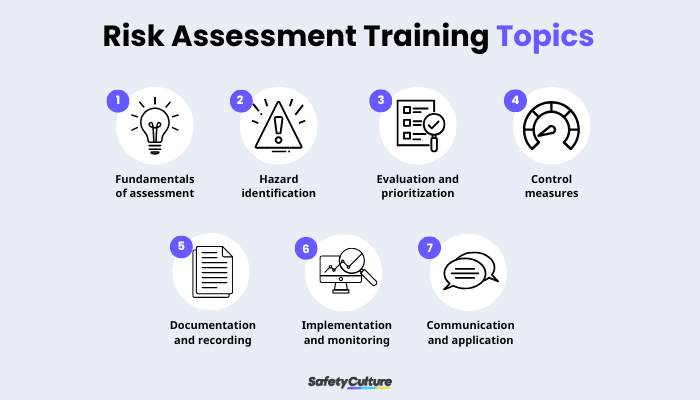
Teams must understand how hazards, their likelihood, and severity interact to manage risks. For example, a factory worker should assess if a machine’s potential for injury justifies adding immediate guarding to prevent an accident.
The staff should be able to systematically spot potential hazards - physical, chemical, biological, ergonomic, or psychosocial to ensure nothing is overlooked. In a hospital, recognizing that needle-stick risks are high in emergency rooms is the first step toward better disposal systems.
Resources are often limited, so prioritization matters. Analyzing a hazard’s likelihood and impact helps teams focus spending where it matters most. For example, on a construction site, investing in fall protection carries more weight than fixing minor trip hazards.
Using a structured framework helps teams move away from quick fixes toward lasting risk reduction plans. Instead of just handing out respirators, a plant might swap a toxic solvent for a safer one, creating a more permanent and effective safety measure.
Clear documentation creates a "paper trail" that keeps everyone accountable and meets legal standards. For example, oil and gas operators must document confined space risks before any maintenance work starts. This proves that safety requirements are met.
Safety measures degrade over time. Regular reviews prevent complacency and ensure protocols still work as the job and regulatory environment change. In high-risk fields like aviation, pharmaceuticals, or nuclear power, constant inspections are the only way to keep standards from slipping.
Risk management is useless if it stays on paper. Safety findings must be shared with everyone involved and turned into daily habits. For instance, training staff to report spills immediately is a simple theory that prevents real-world slips and falls.
Risk assessment training is no longer exclusive to high-risk industries, as safety is a collective responsibility that spans every department and field of work. From leadership to the frontline, learning how to conduct a comprehensive risk assessment equips everyone to apply consistent controls.
Who Needs Training? | Reason | Specific Training Course |
Managers and Supervisors | They make operational decisions, allocate resources, and approve work processes. Without adequate knowledge, they may unintentionally authorize unsafe practices . | Risk-based decision-making Leadership accountability Performance oversight |
Health and Safety Leaders | They design, implement, and audit safety systems. Expertise should go beyond theory to include risk analysis and regulatory compliance. | Advanced hazard identification Incident investigation Risk analysis (e.g., risk matrices and root cause analysis) |
Team Leaders | They translate policy into action, bridging management directives with how workers behave on the ground. | Operational risk assessment Toolbox talk facilitation Job safety analysis |
Frontline Workers | They face hazards directly. Their daily decisions determine whether controls are followed or bypassed. | Practical hazard recognition Personal risk control (e.g., PPE use, stop-work authority) |
Contractors and Third-Party Personnel | They operate under different safety cultures and may be unfamiliar with site-specific risks, increasing their hazard exposure. | Site-specific risk assessment Permit-to-work systems Hazard communication |
In high-stakes environments, the difference between a minor incident and a disaster is the quality of the initial assessment. The risk assessment training course should help workers maintain focus to break the chain of incidents, ensuring small oversights do not evolve into uncontrollable operational failures.
Align training with role-specific risk exposure: Tailor content per department and job function. The hazards a warehouse worker faces daily vary from those of a finance officer at his desk. Customization increases relevance, retention, and practical application.
Integrate practical tools: Using risk assessment tools like risk matrices, digital checklists, and job safety analysis templates during training helps workers become more confident in using them once they are hands-on at work.
Implement a competency review: A structured training and competency checklist helps training managers assess workers’ understanding of the theories. This digital tool helps measure capability, not just attendance.
Maintain a ready-to-deploy course list: Develop a structured module list ahead of time (e.g., basic, intermediate, advanced). These standardized courses speed up onboarding and ensure consistency across departments.
Reinforce through continuous application and monitoring: Training should never be a one-time event. Schedule course refreshers, conduct drills, and review real incidents to embed risk-based thinking into the operations.
SafetyCulture is a mobile-first operations platform adopted across industries such as manufacturing, mining, construction, retail, and hospitality. It’s designed to equip leaders and working teams with the knowledge and tools to do their best work—to the safest and highest standard.
Develop standardized risk assessment modules to ensure consistency across sites, while remaining flexible enough to adapt as new risks emerge. Replace static manuals with mobile-first, bite-sized modules accessible to workers anytime, on-site. Learn how to identify hazards and trends in real-time, empowering workers to take ownership of safety through a unified platform.
✓ Save time and reduce costs
✓ Stay on top of risks and incidents
✓ Boost productivity and efficiency
✓ Enhance communication and collaboration
✓ Discover improvement opportunities
✓ Make data-driven business decisions