The Need for Arc Flash Risk Assessment in Workplace Electrical Safety
Discover how arc flash risk assessments help organizations evaluate electrical hazards and prevent severe injuries and equipment damage.

Discover how arc flash risk assessments help organizations evaluate electrical hazards and prevent severe injuries and equipment damage.
Published 27 Apr 2026
Article by
6 min read
Arc flash risk assessment is the detailed process of identifying electrical equipment and systems that could cause an arc flash and evaluating the danger it poses to workers. This helps site managers and frontline teams set safe working distances and choose the right protective gear for a specific task. Ultimately, this ensures the facility meets safety standards that minimize work-related injuries.
Electrical hazards remain a serious threat in manufacturing, construction, and utilities, accounting for nearly 3% of all workplace fatalities since 2011. Since arc flash incidents make up almost a third of those deaths, conducting a professional arc flash hazard assessment is a necessity for protecting the team. Here are some specifics:
Arc flash incidents are frequent and severe: With estimates of up to 30,000 incidents per year in the US, arc flashes cause serious burn injuries that require long recovery periods.
Electrical work carries a high risk of injuries: Many electrical fatalities are due to high-energy “ignitions”, making this one of the most dangerous workplace hazards.
Most anomalous events occur during maintenance or troubleshooting: Half of arc flash incidents happen during these common electrician tasks. Pre-work checks can identify energized components, helpingworkers implement the right controls.
Human error is a major contributing factor: Improper lockout/tagout or incorrect equipment operation are frequent flashover triggers. Conducting the assessment minimizes these mistakes.
Preventive programs significantly reduce mishaps: Establishing structured safety programs for arc flash hazards can mitigate risk by nearly half, demonstrating that proactive management is far more effective than reactive recovery.
A comprehensive hazard assessment is the essential first step in effective arc flash risk management. Because arc flashes can reach extreme temperatures and cause severe burns, vision loss, or structural explosions, most regulatory bodies strictly mandate this process as the foundation for all subsequent safety controls.
Country | Responsible Agency & Law or Standard Enforced | Specific Requirements |
US | Occupational Safety & Health Administration (OSHA) 29 CFR 1910 National Fire Protection Agency | Workplace hazard assessment Appropriate PPE provision Hazard identification Incident energy estimates Required PPE Safe working distances |
UK | Health & Safety Executive (HSE) | Electrical system maintenance Pre-work checks for electrical equipment or systems, e.g., working near live conductors |
Australia | Safe Work Australia Work Health and Safety Regulations | Pre-work checks on or near energized equipment Arc flash hazard identification Control measures (e.g., isolation, safe work procedures, PPE) |
Canada | Canadian Standards Association | Electrical hazard risk assessment Flash arc analysis with incident energy determination PPE selection Boundaries for energized work |
EU | European Agency for Safety & Health at Work | Electrical risk assessment Safe operation of electrical installation Preventive measures |
Since electrical discharges can reach catastrophic consequences within milliseconds, teams should follow a rigorous evaluation protocol. Meeting arc flash risk assessment requirements ensures hazardous energy is identified and mitigated before workers interact with energized systems.
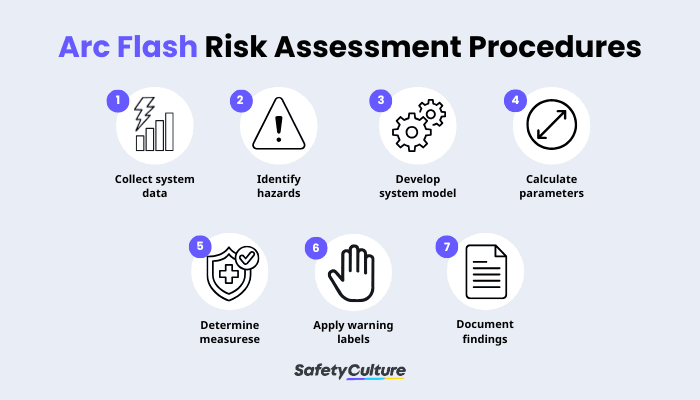
Gather accurate electrical system data and inspect equipment on-site to ensure calculations and hazard evaluations reflect real system conditions. Incomplete data can lead to incorrect incident energy estimates and unsafe PPE recommendations. Collect the following information:
System voltage levels and equipment ratings
Available fault current from the utility or generator
Protective device types and settings
Equipment configuration (switchgear, panelhouse, transformers)
Cable lengths, conductor sizes, and grounding methods
Determine where arc flash events could occur and under what conditions. This focuses the analysis on equipment that presents the greatest risk to workers performing maintenance or troubleshooting. Here are some of the most common examples:
Equipment failure or insulation breakdown
Accidental contact with energized conductors
Short circuits or dropped tools that cause phase-to-phase or phase-to-ground faults
Create a digital model of the electrical distribution system. Specialized software can simulate the electrical faults and evaluate how protective devices respond (e.g., how breakers trip before a worker touches a live wire). This is the only way to accurately measure the danger and provide the right protection to everyone on the shop floor.
Recognized calculation methods (e.g., IEEE arc flash models) estimate the incident energy that could be released during an arc flash. It also helps determine safe approach distances. The common boundaries are:
Arc flash boundary
Limited approach
Restricted approach
Prohibited approach
Select control measures to reduce risk. The goal is to eliminate energized work whenever possible or reduce exposure to arc flash energy. Here are some examples:
De-energize equipment before work.
Install arc-resistant switchgear or protective relays.
Conduct pre-task briefings or toolbox talks on arc flash safety.
Labels communicate critical safety information directly at the equipment location. Electrical equipment such as switchgear assemblies, motor control centers, and electrical paneboards must have labels (e.g., nominal system voltage, incident energy level, shock protection boundaries). This helps workers understand the risk before opening or servicing the equipment.
Proper documentation ensures the study can be updated when electrical systems change. Compile the following results and maintain documentation for safety compliance and future reviews:
Electrical single-line diagrams
Fault current and incident energy analysis results
Arc flash boundary calculations
Equipment labeling information
Recommended safety procedures and electrical PPE requirements
Schneider Electric’s safety auditors reclaimed 60 hours per week by replacing manual Excel entries and paper forms with a streamlined digital platform. By cutting audit times from 30 minutes to just four, they proved that a comprehensive software solution makes complex tasks—like arc flash assessments—significantly faster and more accurate.
SafetyCulture is a mobile-first operations platform adopted across industries such as manufacturing, mining, construction, retail, and hospitality. It’s designed to equip leaders and working teams with the knowledge and tools to do their best work—to the safest and highest standard.
Streamline pre-work reviews by using standardized arc flash templates, hazard checklists, and an integrated PPE registry to minimize manual errors. Instantly share arc boundary calculations and compliance data, while logging near-misses to identify safety trends. Ensure every arc flash risk assessment is thorough, consistent, and easy to manage through a unified platform.
✓ Save time and reduce costs
✓ Stay on top of risks and incidents
✓ Boost productivity and efficiency
✓ Enhance communication and collaboration
✓ Discover improvement opportunities
✓ Make data-driven business decisions