
test


Importance
Evaluating teachers is an important aspect of maintaining quality education. It enables continuous improvement and growth for both individual teachers and the school system as a whole.
Here are the main reasons it matters in practice.
Improves teaching quality: Evaluations reveal both strengths and gaps in areas like lesson delivery, classroom management, and student engagement. With clear feedback, teachers can refine their approach and apply more effective strategies in the classroom.
Supports professional development: Insights from evaluations help schools design targeted training, mentoring, and workplace coaching programs. It ensures that teachers receive relevant support aligned with their individual needs and areas for growth.
Enhances student learning and achievement: Better teaching leads to better learning experiences. As teachers improve their methods, students benefit from clearer instruction, higher engagement, and stronger academic outcomes.
Informs school and HR decisions: Evaluation data provides a structured basis for decisions related to promotion, retention, compensation, and targeted support. It helps maintain fairness while upholding teaching quality.
Strengthens accountability and system quality: Evaluations make teaching performance more transparent and easier to measure. It allows schools and education leaders to monitor standards, identify gaps, and allocate resources where improvements are needed most.
Types of Teacher Performance Evaluation
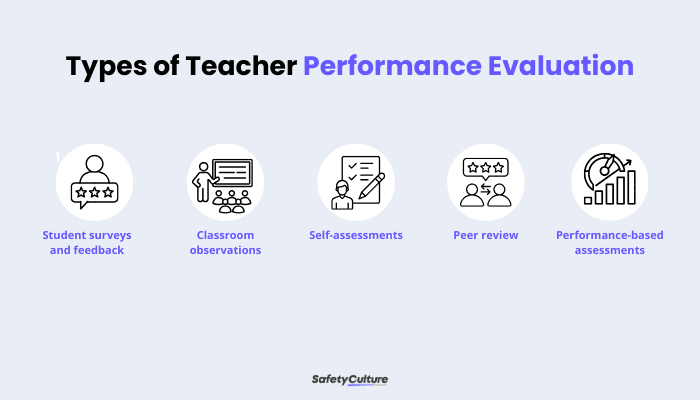
Different evaluation methods offer multiple ways to assess how teaching is delivered and experienced in the classroom. No single approach captures the full picture, which is why schools often combine various methods to create a more balanced and reliable assessment.
Below are the most commonly used approaches and how they work.
Student surveys and feedback
This method gathers input directly from students about their learning experience, engagement, and the quality of lesson delivery. It offers valuable insight into how students receive teaching, not just how instructors intend it.
Pros:
Offers direct insights from students who experience the teaching daily
Highlights what resonates with learners and what needs improvement
Cons:
Responses may reflect bias, such as students' grades or personal preferences
Younger or less mature students may struggle to give meaningful feedback
Classroom observations
These involve administrators or peers evaluating teaching in real time. It also focuses on instructional techniques, classroom management, and teacher-student interactions during lessons.
Pros:
Provides immediate, practical feedback that teachers can apply quickly
Allows evaluators to see actual classroom dynamics and teaching behavior
Cons:
Can create pressure or anxiety that affects teacher performance
Observations may not reflect typical teaching if lessons are staged or prepared
Evaluations can be subjective, depending on the observer
Self-assessment
Self-assessment encourages teachers to reflect on their own practices, identify strengths, and recognize areas for improvement. It promotes ownership of professional growth and continuous learning.
Pros:
Builds self-awareness and accountability
Encourages a growth mindset and continuous improvement
Cons:
Lack of objectivity can affect accuracy
Teachers may overestimate or underestimate their performance
Peer review
This involves teachers observing and evaluating each other's work. Peer review fosters a collaborative environment where feedback draws on shared teaching experiences and practical understanding.
Pros:
Encourages collaboration and knowledge sharing among teachers
Feedback is often practical and grounded in real teaching experience
Cons:
Teachers may hesitate to give honest feedback to avoid conflict
Personal relationships can influence objectivity
Performance-based assessments
This method evaluates teaching effectiveness using measurable indicators such as student outcomes, lesson plans, and instructional delivery. It often relies on data like test scores and student work.
Pros:
Provides a data-driven view of teacher performance
Aligns evaluation with student progress and educational goals
Cons:
External factors can influence student results, affecting fairness
Over-reliance on metrics may overlook important aspects of teaching that are harder to measure
Challenges with Teacher Evaluation
Even with structured frameworks in place, evaluation systems often struggle when applied in real school settings. According to a study,50% of teachers were dissatisfied with their evaluation results.
The following challenges highlight where these systems commonly fall short and how to address them.
Subjectivity and bias
Evaluation results can vary depending on who is observing or assessing the teacher. Personal perceptions, relationships, and unconscious biases may influence ratings, making it difficult to ensure fairness and consistency across all evaluations.
Solution:
Incorporate peer reviews, self-assessments, and student feedback to balance perspectives. Also, establish clear, standardized criteria and provide evaluator training to ensure more consistent and fair assessments.
Inadequate feedback
Feedback provided during evaluations is often too general, vague, or checklist-based, leaving teachers unsure of what to improve. Without specific and actionable guidance, evaluations fail to support real professional growth.
Solution:
Provide clear, specific, and regular feedback throughout the year, rather than relying solely on annual reviews, and align suggestions with practical strategies teachers can implement.
Technical and data issues
Some evaluation systems rely heavily on complex data models or student test scores, which may not fully reflect teaching effectiveness. These methods can overlook important classroom dynamics and create confusion about how teachers can improve.
Solution:
Adopt a balanced approach that combines quantitative data with qualitative insights, such as classroom observations and peer input, and use metrics that directly connect to teaching practices, ensuring data is easy to interpret and apply.
Implementation hurdles
Challenges often arise when organizations introduce evaluation systems without proper preparation, training, or support. A lack of resources, inconsistent standards, and teacher resistance can reduce the process’s overall impact.
Solution:
Communicate goals and expectations clearly before implementation. Provide proper training for evaluators, allocate sufficient resources, and involve teachers in the process to build trust and encourage buy-in.
Empower Your Workforce
Equip your team with the knowledge and skills to operate safely through extensive training programs.
Inconsistent implementation
Inconsistent use of evaluation criteria across teachers or departments can create perceptions of unfairness. When standards are applied differently, it weakens confidence in the system and reduces its effectiveness.
Solution:
Apply evaluation standards uniformly across all teachers. Train evaluators thoroughly and regularly review evaluation practices to ensure consistency and fairness in assessment administration.
Limited professional support after evaluation
Identifying areas for improvement without offering support can leave teachers feeling unsupported and discouraged. Evaluations lose their value if they do not lead to meaningful development opportunities.
Solution:
Link evaluation results with professional support, such as mentoring, training, and collaborative planning, to foster continuous learning and improvement.
How to Evaluate a Teacher Step-by-Step
Evaluating a teacher involves a structured process that examines both teaching practices and student learning, encouraging reflection and continuous improvement.
The steps below outline how to conduct a more effective and well-rounded teacher performance evaluation.
Step 1: Be the right evaluator
Maintain objectivity and avoid personal bias when assessing performance
Focus on actual evidence of learning, not assumptions or impressions
Ensure consistency in how evaluation criteria are applied
Prioritize instructional quality and student engagement during assessment
Step 2: Engage teacher leaders
Involve experienced teachers in the evaluation process to promote collaboration
Conduct orientation or training sessions to explain the purpose of evaluations
Encourage open discussions about improving teaching practices
Build trust so teachers see evaluation as support, not criticism
Step 3: Go beyond just observing
Observe both teacher actions and student responses during lessons
Pay attention to student engagement, participation, and interaction
Review lesson plans, assessments, and student outputs for deeper insights
Conduct both formal and informal observations for a more complete picture
Step 4: Reflect with the teacher
Schedule a post-evaluation discussion to review observations
Encourage teachers to share their own reflections and experiences
Ask about challenges, teaching routines, and areas of difficulty
Acknowledge strengths while guiding them toward improvement
Step 5: Share best practices and next steps
Provide clear and honest feedback about performance and proficiency
Offer practical strategies to improve teaching methods
Encourage the use of student feedback to identify learning gaps
Develop a structured plan for continuous professional growth
Step 6: Use multiple evaluation measures
Combine classroom observations, student feedback, teacher evaluation forms , and self-assessments
Include data such as student performance and learning outcomes
Avoid relying on a single method to assess effectiveness
Use multiple sources to create a more balanced evaluation
Step 7: Apply results for continuous improvement
Use evaluation outcomes to guide professional development efforts
Provide mentoring, coaching, or training based on identified needs
Avoid using results purely for scoring or punitive purposes
Focus on long-term growth and improved teaching quality
Important notice
The information contained in this article is general in nature and you should consider whether the information is appropriate to your specific needs. Legal and other matters referred to in this article are based on our interpretation of laws existing at the time and should not be relied on in place of professional advice. We are not responsible for the content of any site owned by a third party that may be linked to this article. SafetyCulture disclaims all liability (except for any liability which by law cannot be excluded) for any error, inaccuracy, or omission from the information contained in this article, any site linked to this article, and any loss or damage suffered by any person directly or indirectly through relying on this information.