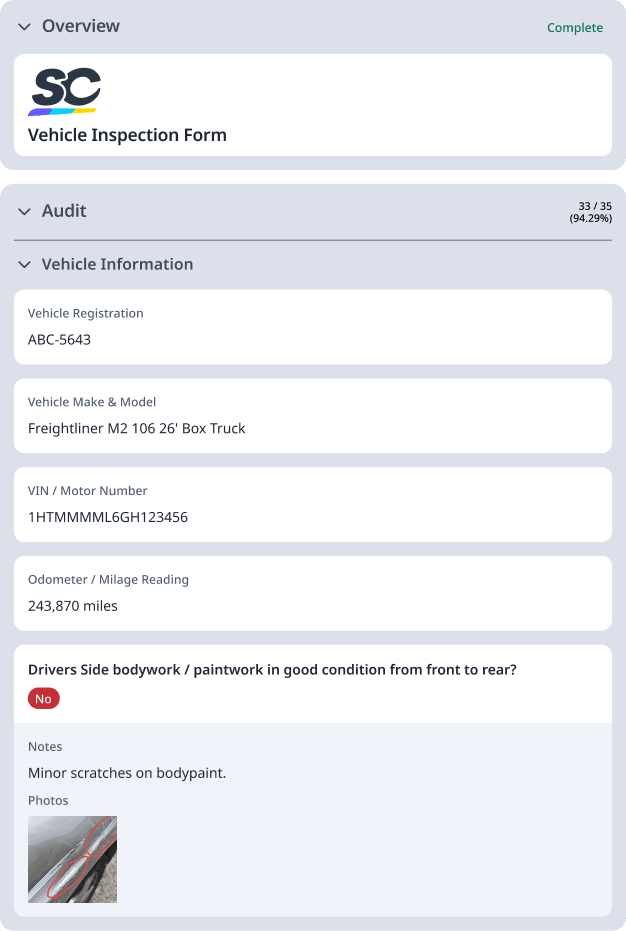
What is a Vehicle Inspection Form?
A vehicle inspection form is a structured checklist used to evaluate the condition, safety, and roadworthiness of a vehicle. It guides drivers, mechanics, or inspectors through a consistent series of checks from basic exterior condition to critical mechanical components, ensuring nothing is missed.
Businesses use these forms to:
Maintain regulatory compliance
Improve safety and reduce breakdowns
Track recurring issues
Standardize inspections across fleets
Whether for daily pre-start checks or periodic maintenance assessments, the form helps capture accurate, actionable information.
Regulatory Requirements Across Regions
Which regulatory requirements must a vehicle inspection form meet across jurisdictions?
Here are the core regulatory elements your vehicle inspection form should capture, by major jurisdiction.
United States (FMCSA/DOT)
Include vehicle identification, date/time, and a checklist of safety‑critical components; the driver must sign the Driver Vehicle Inspection Report (DVIR).
If defects are found, the motor carrier must certify repairs or that repairs are unnecessary before reuse, and retain the DVIR and certifications for 3 months.
Before driving, the driver must be satisfied that the vehicle is safe and review/sign the last DVIR when applicable.
Maintain a separate periodic/annual inspection program and records; retain general inspection/maintenance records for 1 year while in service and 6 months after disposal/transfer.
“No‑defect” DVIRs are no longer required (property carriers since 2014; passenger carriers since 2020), though carriers may still choose to collect them.
Canada (CCMTA NSC Standard 13)
Complete a daily trip inspection every 24 hours using the applicable schedule; carry the schedule in the cab and do not operate with major defects.
Trip inspection report content typically includes: licence plate/unit number, carrier name, date/time, inspection location, defects or “no defects,” driver/inspector printed name and signature, and odometer reading.
Drivers must monitor vehicle condition en route, and report newly discovered defects; vehicles with major defects must not be driven until repaired.
Carriers generally retain trip inspection reports for at least 6 months (check provincial rules; e.g., Alberta specifies 6 months retention and carrying Schedule 1 in vehicle).
Provinces/territories adopt NSC 13 into regulation (e.g., Nova Scotia), so verify local implementation details.
United Kingdom (DVSA)
Conduct a daily walkaround check at least once every 24 hours by the driver or a responsible person; document defects and remove unroadworthy vehicles from service.
Defect reports should record: registration/ID, date, defect details/symptoms, reporter’s name, who it was reported to, assessment, rectification work, and date completed; keep records for at least 15 months.
Safety inspection records must include operator name, date/location, inspector/organisation, vehicle ID, make/model, odometer, list of items inspected, defects, repair details, and a signed declaration of roadworthiness.
DVSA’s recent updates emphasize brake performance assessments within safety inspections and clarify maintenance responsibilities; follow the latest GTMR guidance.
What’s Included in a Vehicle Inspection Form
Formats vary across industries, but what items should be included on a vehicle inspection form?
1. Vehicle & Operator Information
Vehicle make, model, and registration
Odometer reading
Date/time of inspection
Inspector/driver name and signature
2. Exterior Condition
Body damage (scratches, dents, cracks)
Lights (headlights, indicators, brake lights, hazard lights)
Mirrors and glass
Bumpers, steps, and number plates
3. Under-the-Hood Components
Engine oil level
Coolant level
Brake fluid
Power steering fluid
Battery condition
Belts and hoses
4. Tires & Brakes
Tire pressure and tread depth
Spare tire condition
Service brakes
Parking brake
5. Interior & Safety Features
Seatbelts
Horn
Gauges, dashboard warning lights
Wipers and washers
Heater/air-conditioning
6. Operational Checks
Engine performance
Steering responsiveness
Transmission shifting
Acceleration and braking behavior
7. Additional Equipment (if applicable)
Emergency kit (triangle, extinguisher, first aid)
Tools and jack
Load restraints or cargo equipment
8. Inspection Results
Pass/fail notes
Defects or issues found
Urgency level (minor, major, out-of-service)
Corrective actions or maintenance are needed
How to Fill Out a Vehicle Inspection Form
Learn how to use a vehicle inspection form step-by-step to standardize checks, document defects, and keep inspection records consistent across your fleet.
Step 1: Start with basic information
Record the date, time, vehicle details, and your name. This identifies when the inspection occurred and who conducted it.
Step 2: Follow the checklist in order
Move through each section one by one. This minimizes the risk of overlooking important components.
Step 3: Observe, test, and record
For visual checks: note any signs of damage, wear, or leaks.
For operational checks: start the vehicle, test lights, brakes, horn, and steering.
Measure where required (e.g., tire pressure, fluid levels).
Step 4: Use clear, specific notes
Instead of writing “OK” or “Bad,” describe issues:
“Left headlight dim—possible bulb failure”
“Rear right tire low pressure – needs inspection”
Step 5: Mark defects accurately
Select the appropriate pass/fail or defect category and indicate whether the issue requires immediate attention.
Step 6: Sign and submit
Finish by signing the form. If digital, submit through your fleet management or inspection app so the maintenance team is notified instantly.