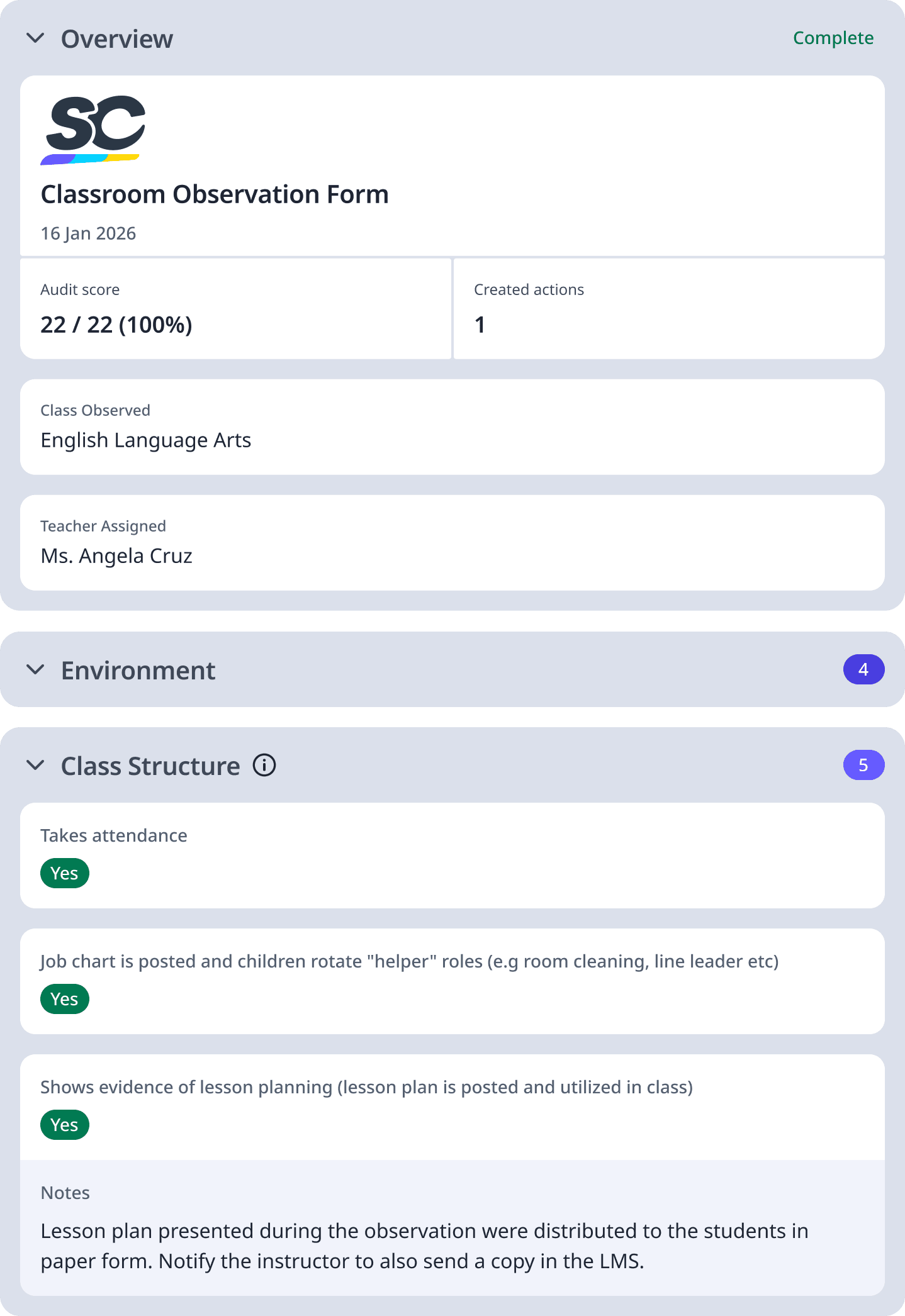
What is a Classroom Observation Form?
A classroom observation form is a standardized tool used by school administrators, supervisors, or peer reviewers to evaluate teaching practices during a lesson. It captures key aspects like lesson delivery, student engagement, classroom management, and instructional quality. These forms support teacher development, performance reviews, and compliance with educational standards, helping identify strengths and areas for improvement without bias.
Benefits of using a Classroom Observation Form
Using a classroom observation form promotes teacher growth through actionable, unbiased feedback; ensures fair evaluations with objective criteria; supports accountability for performance and compliance; fosters collaborative discussions; highlights best practices to improve instruction school-wide; and streamlines documentation to save time all leading to better student outcomes and higher teacher retention.
What’s Included in a Classroom Observation Form?
Most classroom observation forms follow a structured template to ensure consistency. Common sections include:
Observer and Teacher Details: Names, date, time, class/subject, and lesson objectives.
Lesson Structure: Pre-observation notes on planning, plus ratings for introduction, main activities, and closure.
Teaching Methods: Assessments of clarity of instructions, use of resources, differentiation for diverse learners, and active learning techniques.
Student Engagement: Observations on participation, behavior, inclusivity, and response to questions.
Classroom Environment: Notes on management, safety, student-teacher interactions, and physical setup.
Overall Ratings: Scales (e.g., 1-5) for effectiveness, with space for strengths, recommendations, and signatures.
Forms often use checklists, rubrics, or open-ended fields for qualitative feedback.
How do I fill out a Classroom Observation Form?
Filling out the form is straightforward—focus on objective observations rather than judgments. Follow these steps:
Prepare: Review the lesson plan beforehand and arrive early to note setup.
Observe Discreetly: Sit unobtrusively, jot notes on timestamps for specific events (e.g., "10:15 - Group activity started").
Rate Objectively: Use the provided scale; base scores on evidence, like "Students raised hands 80% of the time."
Add Specific Feedback: Highlight positives first (e.g., "Strong use of visuals"), then suggestions (e.g., "Incorporate more wait time after questions").
Debrief: Share the form promptly with the teacher, discuss in a post-observation meeting, and get signatures.
Submit: File digitally or in records for follow-up.